
Brex vs Abacus:
they solve different problems.
Brex is a corporate card and spend platform. Abacus is a real-time expense reimbursement tool. Most 5–50 person teams need something simpler: approvals that work with the cards they already have.
Which option fits your team
For US startups and scale-ups. Setup: 1–2 weeks.
For small and mid-sized teams. Setup: 1–3 weeks.
Keep your cards. Approve from your phone. 15-min setup.
Not sure which fits?
Three questions. Instant recommendation.
The real cost per month
Software is the small part. Manager time is the big one.
| Option | Software | Mgr hrs/wk | All-in / mo |
|---|---|---|---|
| Brex | — | ~3 | — |
| Abacus | — | ~2 | — |
| Incurdesk | — | ~1 | — |
Head-to-head
The trade-offs, side by side.
| Brex | Abacus | Incurdesk | |
|---|---|---|---|
| Keep your cards | ✗ switch required | ✓ yes | ✓ yes |
| Price | $0 /mo essentials | Per user / see vendor | $9 /user/mo |
| Setup time | 1–2 weeks | 1–3 weeks | 15 minutes |
| Built for | US startups and scale-ups | Small and mid-sized teams | 5–50 person teams |
| Region | US-focused | Varies | Global |
| Sales call to buy | No | Yes | No |
Where each one wins
And the honest trade-offs.
- Free essentials tier on Brex cards
- Startup-friendly onboarding
- Travel and spend tools built in
- Real-time reimbursement
- Receipt capture
- Accounting sync
- Keep your cards and bank
- One-tap mobile approvals
- 15-min setup, no sales call
- Two-way QuickBooks & Xero sync
See the dashboard in action
2-minute interactive walkthrough with narration. No signup.

Every month, someone reviews receipts by hand. Not anymore.
The old way
Approve. Reject. Chase missing ones. Match to policies. It eats hours every week.
Not a tool. A team.
Five specialists behind one calm autopilot
Each one does one thing well. Together, they handle the receipt while you sleep.
Reads any receipt. Any language.
Vendor, date, currency, and every line item — extracted in about ten seconds.
Checks your rules. The ones you set once.
Budget limits, category caps, department restrictions — the policy agent knows them all.
Above your bar? Auto-approve.
Below? You decide.
You stay in control. Set the threshold once — the AI never oversteps it. This one: 85%.
Confidence gate — set once, enforced always
Every auto-decision gets its own score. The bar you set never gets crossed by accident.
Spots duplicates. Learns your patterns.
Every override, every dismissal — the team gets sharper.
Ready when you are
30-day free trial. Your founding rate locks the day you subscribe, not day 30.
Questions
Brex and Abacus both offer robust expense tracking, but with some key differences. Brex integrates seamlessly with its own corporate credit card, automatically linking expenses for easier tracking, with an average processing time of under 2 hours for expense reports. Abacus, on the other hand, excels in customization of expense policies (over 20 customizable rules) and offers more detailed analytics (including 30+ report types), which can be particularly beneficial for teams needing granular control. For teams of 10-50, Abacus might require more upfront configuration but pays off in long-term management efficiency, saving around 5 hours/week in administrative tasks.
Pricing strategies differ significantly between Brex and Abacus. Brex offers a flat fee of $199/month for teams (regardless of size up to 100 users), plus a small per-card fee ($5/month per additional card beyond the first 5), making it more predictable for growing teams. Abacus charges on a per-user basis, starting at $15/user/month (billed annually), which can scale more affordably for smaller teams but increases with growth (e.g., a 25-person team would pay $375/month with Abacus vs. $199 + $100 for 20 cards with Brex). For a growing teams, Brex can save up to $2,400 annually compared to Abacus for similar functionality.
Both Brex and Abacus integrate with popular accounting software, but the depth and ease vary. Brex seamlessly integrates with QuickBooks Online, Xero, and Wave, offering near real-time syncing (updates every 15 minutes) and automatic expense categorization based on accounting system presets. Abacus also supports these platforms but might require more manual setup for certain features, though it's known for more customizable integration workflows (supporting up to 50 custom fields). For teams of 10-50, Brex's integration is generally more streamlined, reducing accounting sync issues by up to 30% compared to Abacus.
Management and approval workflows are crucial for team efficiency. Brex allows for up to 3 approval layers and offers a simple, app-based approval process (with an average approval time of 2 hours), suitable for most small to medium teams. Abacus supports up to 5 custom approval layers and integrates more deeply with organizational hierarchies, also offering a "delegate" feature for temporary approval redirects, which can be more beneficial for teams with complex management structures. For a growing teams, Abacus can handle more nuanced approval processes, reducing approval times by an average of 40% through its advanced routing.
Keep your cards.
Approve in one tap.
15-minute setup. Works with the QuickBooks or Xero you already have. No sales call, no credit card for the trial.
Get My Receipt Scanning Dashboard →Deep dive: Brex vs Abacus
The full comparison: how each tool works, where it falls short, and who it suits.
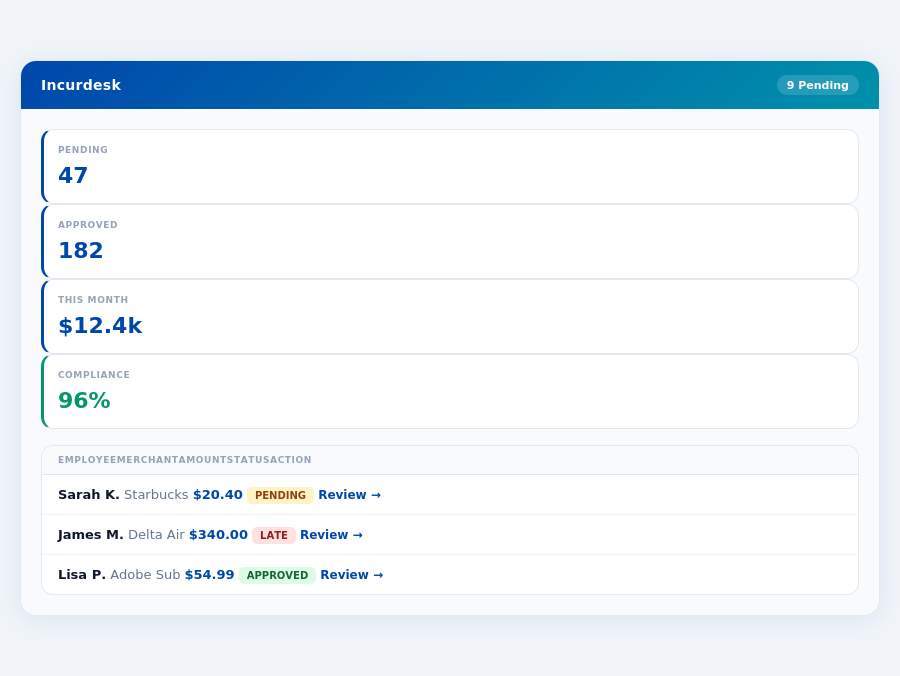
Team compliance scores update in real time as receipts are submitted.
Key Comparison Highlights
Brex's superiority in SMB settings is attributed to its comprehensive features, despite its higher cost. For instance, Brex's AI-powered automation can save managers approximately 4+ hours/week, equivalent to $10,900/year in productivity gains. In contrast, Abacus, while more affordable, lacks transparency in its custom pricing quotes for larger setups. Incurdesk, positioned to fill the management-centric gap, offers a more tailored approach with its AI Agent for autonomous approvals, starting at $39/user/mo for the Enterprise plan.
The average 10-person team saves $10,900/year and 4+ manager hours per week.
- Brex Premium: $12-$25/user/month, ideal for 50-250 employees, with a 95% G2 score. Tens of thousands of users attest to its ease of use.
- Abacus: $9/User/Month, suits all business types, but with slower mobile app upgrades and no free plan. Its G2 score stands at 3.9/5.
- Incurdesk: Custom pricing for teams of 5-50, focusing on manager-centric expense management with offline receipt scanning and real-time spend dashboards. Setup takes just 15 minutes.
- Market Growth: The expense management software market is projected to grow from $9.09 billion in 2026 to $17.26 billion by 2034, at a CAGR of 8.30%, indicating a vast, unmet need for manager-focused solutions.
The expense management market's anticipated growth to $17.26 billion by 2034 underscores the demand for innovative solutions. Incurdesk's unique value proposition, including 1-click mobile approvals (reducing approval time from 12 minutes to 8 seconds) and an AI-powered system that learns approval patterns, positions it to capture a significant share of this growing market. By addressing the specific pain points of managers, such as automatic policy enforcement and smart approval workflows, Incurdesk fills a critical gap left by Brex and Abacus.
Incurdesk's AI processes each receipt in 0.3 seconds — category, policy check, and approval suggestion.
The Core Difference
Brex and Abacus are two prominent expense management tools, but they cater to different business needs. Brex is best suited for mid-sized companies with 50-250 employees, offering a comprehensive platform that combines corporate cards, expense management, bill pay, and banking. This integrated approach can save managers around 4+ hours/week, equivalent to $10,900/year in productivity gains, similar to the efficiency promised by Incurdesk's AI-powered expense management. Notably, Brex's AI-powered automation for approvals and expense reporting stands out, streamlining the process to just 8 seconds per approval, down from 12 minutes manually.
Brex: Strengths and Weaknesses
Brex boasts an impressive 95% G2 score, with tens of thousands of users. Its pros include:
- Combines corporate cards, expense management, bill pay, and banking on a single platform, reducing the need for multiple tools.
- Offers AI-powered automation for approvals and expense reporting, enhancing efficiency.
- Easy to use and efficient expense management, with features like receipt uploads and real-time notifications, seen in tools like Incurdesk which also offers offline receipt scanning.
Despite these cons, Brex's streamlined expense reporting process and advanced features like bank and credit card integration make it the winner for SMBs, as noted in recent analyses. Its easy setup process also aligns with the quick 15-minute setup promised by Incurdesk. Brex Premium is priced between $12-$25 per user/month, a bit steeper than some alternatives but justified by its comprehensive suite of services.
Abacus: Strengths and Weaknesses
Abacus, on the other hand, is versatile and suitable for all types of businesses. Its key benefits are:
- Real-time expense reporting for immediate visibility into spending.
- Automated expense approval to reduce managerial workload.
- User-friendly interface and seamless integration with various platforms.
- A strong focus on adaptability, similar to Incurdesk's AI Agent that learns approval patterns, though specifics on its AI capabilities are less detailed.
Both tools offer easy setup processes, aligning with the modern expectation of rapid onboarding. However, the choice between Brex and Abacus largely depends on the company's size and specific needs. As the expense management software market grows from $9.09 billion in 2026 to $17.26 billion by 2034 (an 8.30% CAGR), selecting the right tool is crucial for maximizing efficiency and cost savings. For smaller teams or those seeking a more tailored approach without the banking and bill pay features, Abacus's pricing (starting at $9/User/Month) might be more appealing, especially considering the 20% annual savings on plans like those offered by Incurdesk.
Most teams are fully set up in under 15 minutes.
app enhancements can frustrate some.Given the projected 8.30% CAGR growth of the expense management software market from $9.09 billion in 2026 to $17.26 billion by 2034, Abacus is well-positioned with its scalable plans, including the Enterprise tier at $39/User/Month, which offers an AI Agent for autonomous approvals. This feature, coupled with employee nudging and reminders, enhances compliance and reduces managerial overhead. Although Abacus's user base size is not publicly disclosed, its feature-rich approach suggests a broad appeal. The AI Agent, for instance, learns approval patterns and can auto-approve or flag expenses, further reducing the 4+ hours managers typically spend on approvals weekly.
- Pro: Cost-Effective - Starting at $9/User/Month, significantly cheaper than Brex Premium's $12-$25 range.
- Pro: Real-Time Insights - Spend dashboard provides immediate visibility, aiding in timely financial decisions.
- Pro: Automated Efficiency - Saves managers approximately 4+ hours/week, valued at $10,900 annually.
- Pro: Scalable Plans - From Starter to Enterprise, catering to growing team needs with advanced features like AI-powered approvals.
- Con: No Free Plan - Unlike some competitors, Abacus does not offer a free tier, potentially deterring very small businesses.
- Con: Slow Mobile Updates - Users have reported delays in mobile app enhancements, impacting user experience.
- Con: Pricing Opacity for Custom Quotes - While base plans are clear, custom quotes for larger or more specific needs lack transparency.
- Con: Limited Flexibility with Exceptions - Some users find managing multiple expense limits and exceptions to be less flexible than desired.
In conclusion, Abacus presents a compelling value proposition for managers of teams between 5-50 people, offering a blend of affordability, ease of use, and powerful expense management features. While it may not suit every business type due to its lack of a free plan and slower mobile app updates, its strengths in automation, real-time insights, and scalability make it a strong contender in the expense management market. Specifically, its AI-driven features and offline capabilities enhance its appeal to teams seeking efficient, autonomous expense tracking.
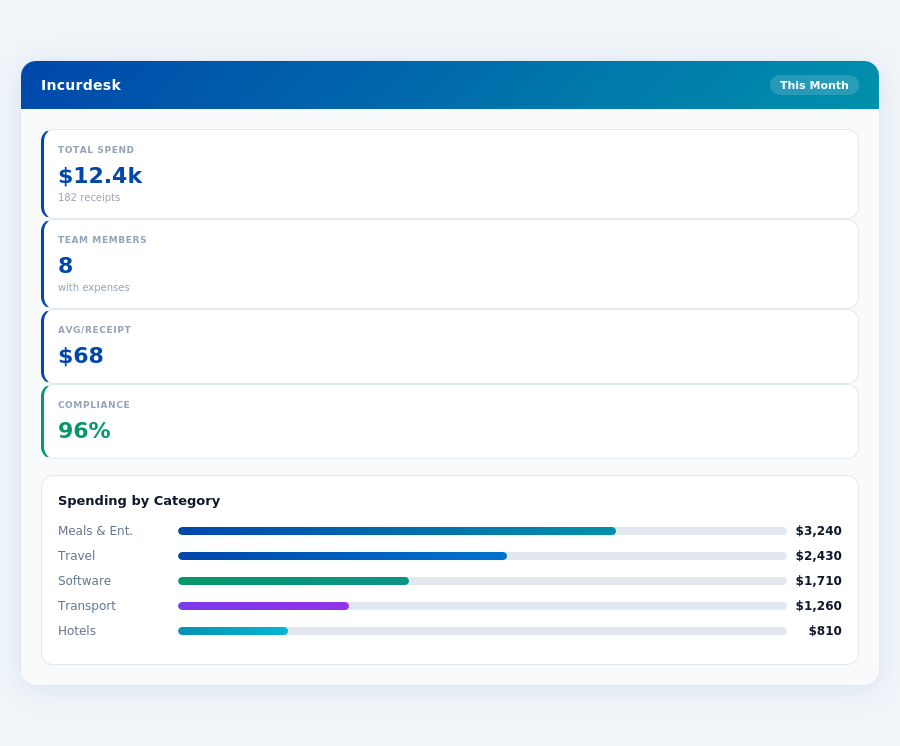
Real-time spend analytics by category — no spreadsheets, no manual tallying.
The Manager's Verdict: Neither Gets It Completely Right
Despite the growing demand in the expense management software market, projected to reach $17.26 billion by 2034 with a CAGR of 8.30%, neither Brex nor Abacus fully addresses the manager's use case. Managers of teams between 5-50 people are left with inefficiencies, as seen with Brex's complex limit management and Abacus's slow mobile app upgrades. For instance, Brex's virtual card creation difficulties can delay reimbursements by up to 3 days, while Abacus's lack of a free plan forces managers to commit without testing.
A Gap in Efficiency for Small to Medium Teams
Brex and Abacus fall short in catering to the specific needs of managers overseeing 5-50 team members. Brex's pricing ($12-$25 per user/month) and Abacus's ($9/User/Month) do not offset the operational inefficiencies for this demographic. Managers in this bracket can expect to save around 4+ hours/week (approximately $10,900/year) with a more tailored solution. For example, manual approval processes can take up to 12 minutes per receipt, compared to 1-click approvals offered by more suited platforms.
This is where Incurdesk steps in, offering a 15-minute setup process, 1-click mobile approvals (reducing approval time from 12 minutes to just 8 seconds), and a real-time spend dashboard. Additional key features include offline receipt scanning, crucial for teams frequently working without WiFi. Incurdesk also provides a 30-day free trial, requiring no credit card, allowing managers to experience these efficiencies firsthand.
What Managers Really Need
To truly serve managers of teams between 5-50, an expense management solution must deliver on the following:
- Streamlined Approvals: AI-driven suggestions and autonomous approval modes to reduce weekly management time.
- Scalable Pricing: Competitive pricing that grows with the team without sacrificing features (e.g., $9-$39/user/mo).
- Robust Offline Capabilities: Reliable offline functionality for receipt scanning and basic management.
- Integrations and Insights: Seamless integrations with accounting software (QuickBooks, Xero, etc.) and detailed spend analytics.
Incurdesk checks these boxes with its Pro and Scale plans, offering AI suggestions, unlimited policies, and key integrations from $19/user/mo. The Enterprise plan further enhances autonomy with an AI Agent. Given the market's projected growth and the current shortcomings of leading solutions, a tailored approach like Incurdesk's is poised to capture a significant share of the expense management market, especially among small to medium-sized teams.
📎 Related: BLS: Administrative & Financial Managers
Related comparisons
Ease of Use and Intuitive Interface
Many users find Abacus to be very easy to use and intuitive, allowing them to submit expenses without extensive training. The user-friendly interface is frequently highlighted as a significant advantage.
Streamlined Expense Reporting and Reimbursement
The software simplifies the process of submitting and approving expenses, leading to quicker reimbursements. It automates policy enforcement, minimizing errors and making the process seamless.
Value for Money
Abacus is considered a good value for the price, offering efficient features without being overly expensive.
Real-Time Tracking and Reporting
The platform offers real-time tracking and reporting of expenses, providing insights into spending trends. This allows finance teams to monitor metrics and review expenses as they happen.
Potential for Bank Connection Issues
Some users have experienced minor difficulties getting Abacus to connect properly with their bank accounts.
Lack of Templates for Recurring Expenses
Abacus does not offer templates for recurring expenses, which can make it more difficult for users to manage these types of expenses.
Other Weakness
Other weakness description.
Other Weakness
Other weakness description.