
Dental Equipment Purchases vs Repairs: How to Record Each
A practical, data-backed guide to controlling costs and automating expense workflows.
When it comes to expense management for dental practice, understanding the tax implications of purchasing new equipment versus repairing existing equipment is crucial for maximizing tax benefits and avoiding IRS penalties. To determine whether to purchase or repair equipment, you need to know the current IRS rules for immediate expensing, such as Section 179 and bonus depreciation, versus capitalizing and depreciating assets. Accurate recording is key to ensuring you take advantage of the right tax benefits. For a complete overview, see our expense management guide.
Dental Equipment Purchases vs Repairs: Understanding the IRS Rules
Dental equipment purchases and repairs can have different tax implications. To understand the IRS rules, it's essential to know the distinction between these two options.
Repairs that restore property to its original condition without adding value or extending its useful life are generally deductible in the year incurred.
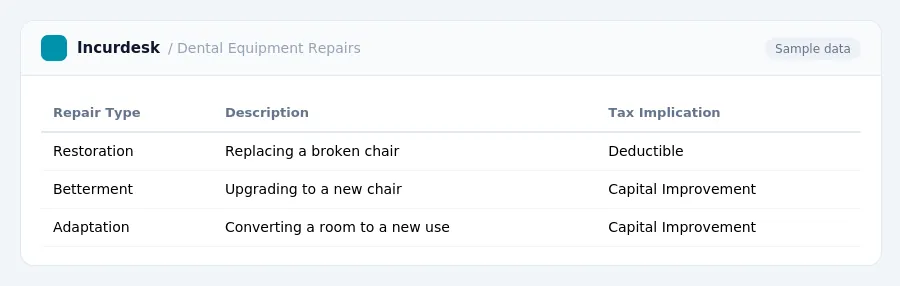
The IRS uses the BAR test to determine the classification of repairs versus capital improvements:
- Betterment: If the repair improves the property, it may be considered a capital improvement.
- Adaptation: If the repair adapts the property to a new or different use, it may be considered a capital improvement.
- Restoration: If the repair restores the property to its original condition, it is generally considered a deductible repair.
When determining whether a repair is deductible, ask yourself:
- Does the repair restore the property to its original condition?
- Does the repair add value or extend the useful life of the property?
Use the BAR test to guide your decision, and keep accurate records to ensure compliance with IRS regulations.
| Repair Classification | General Rule |
|---|---|
| Repair | Deductible in the year incurred |
| Capital Improvement | Capitalized and depreciated |
Section 179 Deduction for Dental Equipment
The Section 179 deduction is a tax incentive that allows small businesses, including dental practices, to deduct the full cost of qualifying equipment in the first year it is placed in service.
When using the Section 179 deduction, it's essential to understand that the deduction is capped at the aggregate taxable income from the active conduct of the business. This means that if your business has a net operating loss, the Section 179 deduction will be reduced accordingly.
To qualify for the Section 179 deduction, the equipment must be used more than 50% for business purposes. Dental practices should consult with their accountant or tax advisor to ensure that their equipment meets the necessary requirements and to determine the maximum amount of the Section 179 deduction they can claim.
Bonus Depreciation for New Dental Equipment
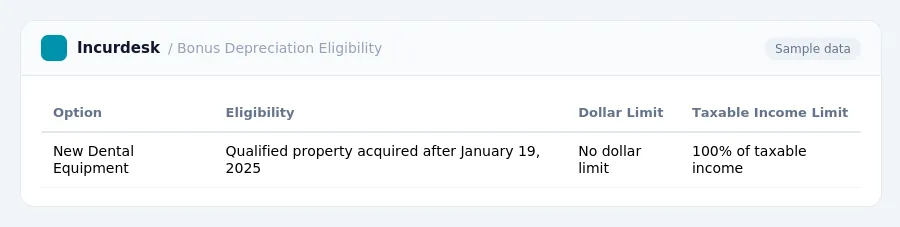
| Option | Eligibility | Dollar Limit | Taxable Income Limit | Depreciation Percentage |
|---|---|---|---|---|
| Bonus Depreciation | Qualified property acquired after January 19, 2025 | No dollar limit | 100% | |
| Section 179 Deduction | Varies (check with the IRS) | Varies (check with the IRS) | Varies (check with the IRS) | Varies (check with the IRS) |
Categorizing Repairs for Immediate Deductibility
When it comes to categorizing repairs, the goal is to ensure that they are immediately deductible. To achieve this, you need to distinguish between repairs and capital improvements.
- Repairs are ordinary and necessary expenses that maintain or improve a property's condition. They are deductible in the year incurred.
- Capital improvements, on the other hand, are expenditures that add to the property's value or extend its useful life. These are depreciated over time.
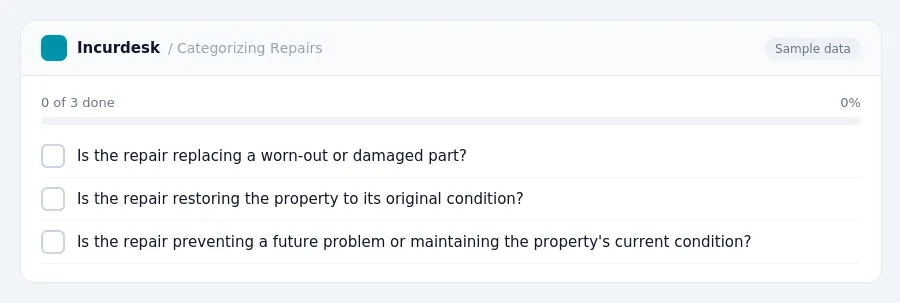
To categorize a repair as immediately deductible, ask yourself:
- Is the repair replacing a worn-out or damaged part?
- Is the repair restoring the property to its original condition?
- Is the repair preventing a future problem or maintaining the property's current condition?
For example, repairing a broken chair or replacing a worn-out dental instrument would be considered a repair and would be immediately deductible. However, if you upgrade to a new, more advanced dental instrument, it may be considered a capital improvement and would be depreciated over time.
Remember to keep accurate records of all repairs, including receipts and descriptions of the work performed. This will help you distinguish between repairs and capital improvements and ensure that you are taking advantage of the tax benefits available to you.
| Repair | Capital Improvement |
|---|---|
| Replacing a worn-out dental instrument | Upgrading to a new, more advanced dental instrument |
Accurate Recording for Tax Benefits and Compliance
To take advantage of tax benefits and avoid IRS penalties, it's essential to accurately record dental equipment purchases and repairs. This involves making informed decisions about when to expense or depreciate assets, and when to categorize repairs as immediate deductions.
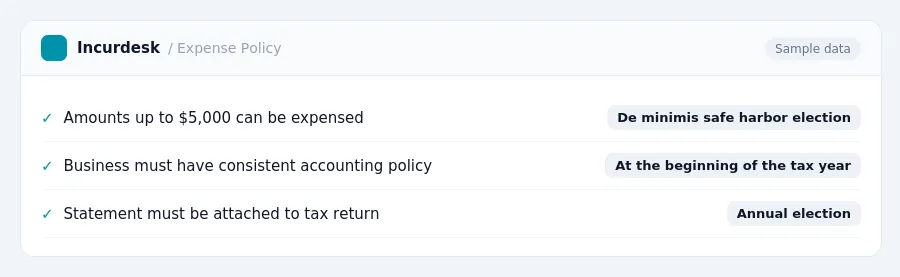
The de minimis safe harbor election allows businesses to expense amounts up to $5,000 without having to account for them separately. To use this election, a business must have a consistent accounting policy in place at the beginning of the tax year and expense the amounts on their books.
Businesses must make the de minimis safe harbor election annually by attaching a statement to a timely filed tax return. This statement should include the following information:
- The business's name and tax identification number
- The tax year for which the election is being made
- A statement that the business is electing the de minimis safe harbor
By following these steps and maintaining accurate records, dental practices can ensure compliance with IRS rules and maximize their tax benefits.
Keeping this simple: Incurdesk lets your team snap a photo of a receipt and fills in the details for you. It is built for small dental practice teams. Try it free.
Stop losing 4+ hours a week
30-day free trial · No credit card · Setup in 15 minutes