
Electrician License and CE Reimbursement Rules
A practical, data-backed guide to controlling costs and automating expense workflows.
To ensure licenses remain valid and employees are properly reimbursed, businesses need to understand their state's CE requirements and reimbursement policies. For the bigger picture, see our guide to electrical contractor expense management software. For a complete overview, see our expense management guide.
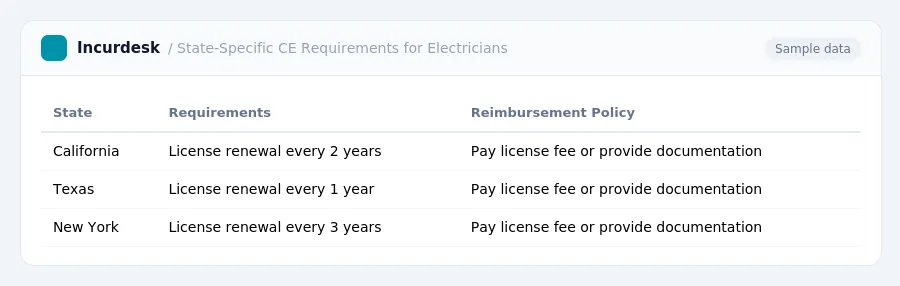
State-Specific CE Requirements for Electricians
In the United States, electricians must complete continuing education (CE) requirements to maintain their licenses. The requirements vary by state, but most states require electricians to complete a certain number of hours of CE every year.
In Arkansas, journeyman and master electricians must complete 8 hours of Code Changes covering the 2026 National Electric Code (NEC) to renew their licenses. The licenses expire annually on the date indicated on the license.
To meet these requirements, electricians in Arkansas must complete the required 8 hours of CE. This can be done through online courses or other approved training programs.
For example, an electrician in Arkansas may choose to complete 8 hours of CE through an accountable plan, such as an online course or a workshop. The plan must be approved by the Arkansas State Board of Examiners.
The Arkansas State Board of Examiners requires that electricians complete 8 hours of CE every year to maintain their licenses. This includes 2 hours of CE on NEC changes, 2 hours of CE on electrical safety, and 2 hours of CE on electrical codes.
It's worth noting that the 8-hour requirement may vary depending on the specific job or industry, and electricians may need to complete additional CE hours depending on their specific circumstances.
In other states, electricians may be required to complete CE hours depending on their specific job or industry.
This requires:
- A clear business connection for the expense
Federal and state tax laws regarding fringe benefits and reimbursements can change, as seen with the permanent elimination of the exclusion for qualified moving expense reimbursements. As a result, businesses must review their policies and procedures to ensure compliance.
Note: The amount of reimbursement, the method of reimbursement, and the deadline for reimbursement will vary depending on the specific circumstances of the employee and the business.
State-Led CE Providers and Online Courses
Some states allow fully online courses, while others have limits on the number of CE hours that can be completed online. For example, some states allow 40 hours of online CE required for electrician licensing, while others limit it to 16 hours. Additionally, some states require a minimum number of in-person CE hours, such as 20 hours per year. It is essential to check with the relevant state licensing board to determine the specific rules and guidelines for your state.
CE providers must also be approved by the state licensing board, and this approval status can change. For instance, one state may have a provider that was approved in 2020, but no longer is, while another state may have a provider that was approved in 2022, but has since changed its policies. It is crucial to verify the status of CE providers and their approved policies with your state licensing board.
When selecting an online course provider, consider the following:
- Check if the provider is approved by your state licensing board.
- Verify the provider's policies and rules for state-specific CE requirements.
- Ensure the provider offers courses that meet the required number of hours for your state.
- Look for providers that offer a refund policy in case the course does not meet the required hours.
- Read reviews and testimonials from previous customers to get a sense of the provider's reputation and quality of courses.
Tax-Advantaged Reimbursement Options
Tax-Advantaged Reimbursement Options for Small Electrical Contractor Businesses
As a small electrical contractor business, understanding tax-advantaged reimbursement options is crucial for maintaining compliance and supporting employee development. One option is to use an accountable plan, which allows businesses to reimburse employees for training expenses in a tax-advantaged way. This can include attending workshops, seminars, or online courses that qualify as continuing education (CE) hours.
To qualify for reimbursement, employees must have completed the training within the past two years, and the business must maintain accurate records of the training hours.
They should also keep accurate records of the training hours and ensure that the reimbursement is made in a timely manner.
These rates apply to the actual business use of the vehicle, not the total miles driven.
To ensure compliance, businesses should consult with a tax professional or accountant who is familiar with the specific rules in their state.
Tax rules, limits and rates change. Confirm current figures with the IRS or your accountant before you file.
Keeping this simple: Incurdesk keeps receipts and approvals together, so you know exactly what to reimburse. It is built for small electrical contractor teams. Try it free.
Stop losing 4+ hours a week
30-day free trial · No credit card · Setup in 15 minutes