Equipment Maintenance Spend for a Fitness Studio
A practical, data-backed guide to controlling costs and automating expense workflows.
For small fitness studio businesses, accurately managing equipment maintenance expenses is crucial for tax purposes. To deduct expenses related to maintaining their equipment, businesses must separate routine repairs from capital improvements. Knowing the rules for depreciation, expensing options like Section 179 and bonus depreciation, and the importance of accurate record-keeping is essential. For the bigger picture, see our guide to expense management for fitness studios. For a complete overview, see our expense management guide.
Depreciation and Expensing Options
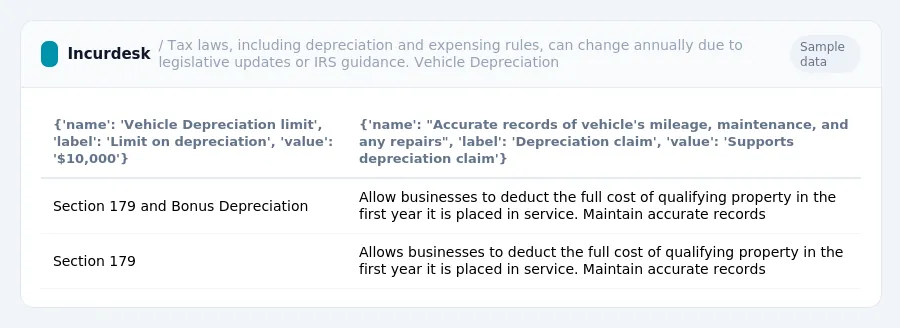
Tax laws, including depreciation and expensing rules, can change annually due to legislative updates or IRS guidance.
Vehicle Depreciation
This limit applies to the actual cost of the vehicle, not the sale price. Keep accurate records of the vehicle's mileage, maintenance, and any repairs to support your depreciation claim.
Section 179 and Bonus Depreciation
Section 179 allows businesses to deduct the full cost of qualifying property in the first year it is placed in service. However, the Section 179 deduction is phased out for larger businesses.
Accurate Record-Keeping
Maintaining accurate records is crucial to support depreciation and expensing claims. Keep detailed records of:
- The cost of equipment and property
- Mileage and maintenance records
- Repair and depreciation records
- Any changes to the equipment or property
By following these guidelines and maintaining accurate records, you can take advantage of depreciation and expensing options to reduce your tax liability and minimize your tax burden.
Keeping this simple: Incurdesk turns submitted expenses into clean expense reports. It is built for small fitness studio teams. Try it free.
Leveraging Bonus Depreciation
The first-year bonus depreciation limit varies depending on the type of asset. For vehicles under 6,000 lbs GVWR, the limit is $20,300. For larger vehicles, the limit is $31,300 for 2025 SUVs up to 14,000 lbs.
To claim bonus depreciation, small fitness studio businesses must keep accurate records of their equipment and property. This includes:
- Receipts for the purchase or lease of equipment
- Records of the equipment's condition at the time of purchase and at the end of the first year
- Proof of the equipment's use or non-use in the business
Businesses should consult with a tax professional or accountant to ensure they are meeting the requirements for bonus depreciation. Additionally, they should verify the accuracy of their records and ensure compliance with all applicable tax laws and regulations.
Equipment Maintenance Spend for a Fitness Studio
As a small fitness studio business, you need to understand how to deduct expenses related to maintaining your equipment for tax purposes. To support these deductions, you need to know the rules for routine repairs versus capital improvements.
For routine repairs, you can expense qualifying equipment purchases immediately if you meet certain criteria. To qualify, your invoices must be for:
Keep in mind that the IRS Safe Harbor Election allows small businesses to expense equipment purchases up to $2,500 per item or per invoice. However, this election only applies to equipment purchases that are used in a commercial capacity.
It's also worth noting that the Section 179 deduction begins to phase out dollar-for-dollar once total qualifying equipment purchases exceed $4,090,000. This means that you may need to reevaluate your equipment purchases and maintenance expenses if you have a large number of qualifying items.
To support these deductions, it's essential to keep accurate records of your equipment maintenance and repairs. This includes receipts, invoices, and maintenance records. You can also consider using a spreadsheet or accounting software to help you track your expenses.
The rules in this guide
| Amount | Required | In Incurdesk |
|---|---|---|
| Above $75 | Itemised receipt | Checked on every expense |
| Above $250 | Written business purpose | Checked on every expense |
| Above $500 | Names of attendees | Checked on every expense |
| Above $5,000 | Senior sign-off; never auto-approved | Checked on every expense |
Each rule is checked on every expense by Incurdesk’s approval agent.
Understanding the Rules for Routine Repairs
As a fitness studio owner or office manager, it's essential to understand the rules for routine repairs to equipment to claim the necessary expenses on your tax return. The rules are outlined below:
- The dollar amounts for safe harbor elections for repairs and supplies can be subject to change.
- Equipment can be new or used, but it must be newly acquired by your business and not from related parties. This means that if you purchased equipment from a related party, you can't claim the repair expenses on your tax return.
- You must document the repairs and supplies you incur in a detailed and organized manner. This includes taking photos, keeping receipts, and tracking the dates and times of the repairs.
- The repair expense must be related to the equipment's normal and expected use in the business. This means that if you're using the equipment for personal purposes, you won't be able to claim the repair expenses.
- You must report the repair expenses on your tax return, using Schedule C (Form 1040). You can claim the repair expenses as a business expense, which can help reduce your taxable income.
- The repair expenses must be substantiated with records and documentation, and you must keep them for at least three years in case of an audit.
By following these rules and keeping accurate records, you can claim the necessary expenses to reduce your tax liability and ensure compliance with the rules.
Accurate Record-Keeping and Deductions
Maintaining detailed records is crucial to substantiate deductions for equipment maintenance spend in a fitness studio. To support these deductions, it is essential to track and document every purchase, installation, and repair of equipment. This includes:
- Purchase contracts and invoices
- Delivery receipts
- Installation logs
- Proof of payment
These records should be kept for at least three years from the date of acquisition. It is recommended to use a combination of digital and physical records, such as a spreadsheet or a separate document for each piece of equipment, to ensure completeness and accuracy.
When recording equipment maintenance expenses, be sure to note the date, description, and cost of each item. This will help you to accurately calculate and claim your deductions.
Tax rules, limits and rates change. Confirm current figures with the IRS or your accountant before you file.
AI expense management for finance teams and whoever keeps the books. It checks every expense against your rules, approves the routine ones and chases missing receipts for you.
Try it free for 30 days →Stop losing 4+ hours a week
30-day free trial · No credit card · Setup in 15 minutes