
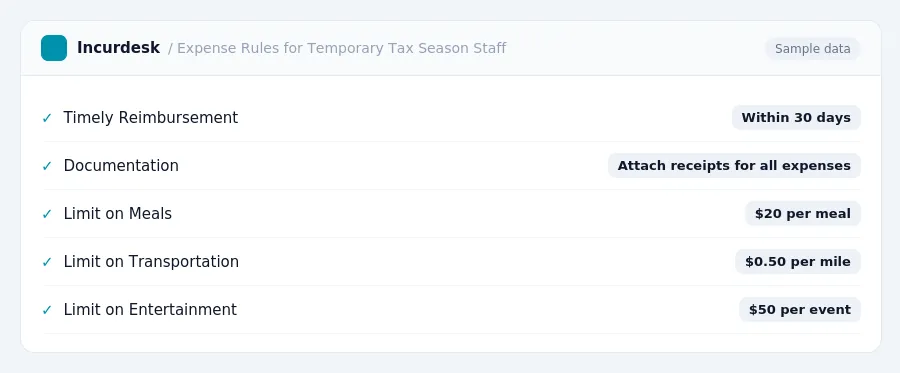
Expense Rules for Temporary Tax Season Staff
A practical, data-backed guide to controlling costs and automating expense workflows.
Small accounting businesses can properly reimburse temporary tax season staff for expenses by following the IRS guidelines for deducting business-related expenses. To ensure compliance and avoid unexpected tax liabilities, it's essential to understand what expenses are deductible, the correct rates and limits to apply, and common pitfalls to avoid. Effective accounting expense management for under $10/user (2026) can help streamline this process and reduce administrative burdens.
Understanding IRS Standard Mileage Rates for Temporary Tax Season Staff
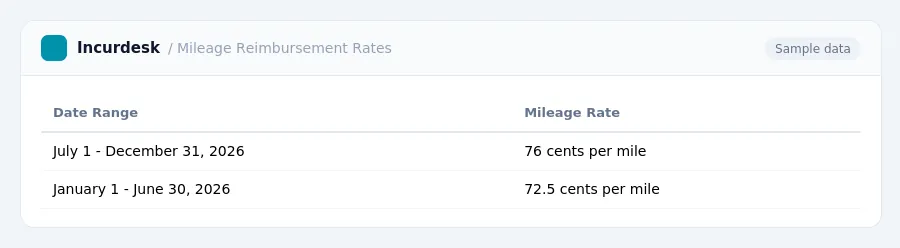
The IRS standard mileage rate for business use of a personal vehicle is an important factor to consider when reimbursing temporary tax season staff for their expenses. For miles driven from July 1, 2026, through December 31, 2026, the rate is 76 cents per mile. For miles driven from January 1, 2026, through June 30, 2026, the rate was 72.5 cents per mile.
To calculate the total mileage reimbursement, you can multiply the number of miles driven by the applicable rate.
Keep in mind that the IRS mileage rate may be subject to change, so it's always a good idea to check the IRS website for the most up-to-date information.
Additionally, the special Meals and Incidental Expenses (M&IE) rates for taxpayers in the transportation industry are $80 per day for travel within the continental United States (CONUS) and $86 per day for travel outside the continental United States (OCONUS) for 2026-2027.
Remember to follow all applicable tax laws and regulations when reimbursing your temporary tax season staff, including federal income tax withholding, Social Security, and Medicare tax rules. Employers must withhold and pay employment taxes on their wages, and the Work Opportunity Tax Credit (WOTC) may be available for certain employees.
Reimbursement Guidelines for Lodging, Meals, and Incidental Expenses
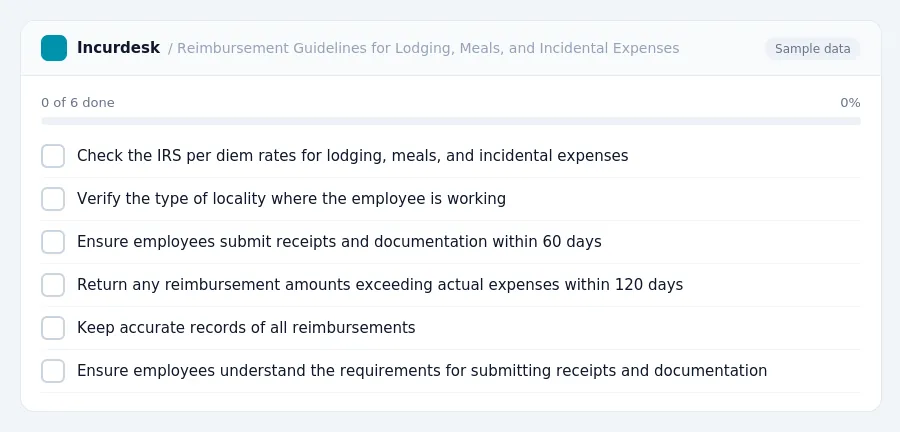
The IRS sets per diem rates for lodging, meals, and incidental expenses (M&IE) that can be used as a guide for reimbursing temporary tax season staff.
The rate for incidental expenses only is $5 per day. To determine the correct rate, you must first identify the type of locality where the employee is working.
Per Diem Rates:
To ensure that reimbursements are tax-free to the employee, they must meet three requirements: Business Connection, Adequate Accounting, and Return of Excess. This means that employees must submit receipts and documentation within 60 days and return any reimbursement amounts exceeding actual expenses within 120 days.
Receipts are mandatory for all lodging expenses, regardless of the amount, for 2026. Be sure to keep accurate records of all reimbursements and ensure that employees understand the requirements for submitting receipts and documentation.
Common Pitfalls to Avoid in Reimbursing Temporary Tax Season Staff
When reimbursing temporary tax season staff, it's essential to avoid common pitfalls that can lead to compliance issues and unexpected tax liabilities. Here are some potential issues to watch out for:
- Failure to provide timely reimbursement can lead to employees deducting expenses on their tax returns, which may result in duplicate deductions and increased tax liabilities for the business.
- Inadequate record-keeping can make it difficult to substantiate expenses and comply with IRS regulations.
- Lack of documentation can lead to disputes with employees and audits by the IRS.
It's also important to note that the IRS sets specific guidelines for reimbursing employees for expenses, and failing to follow these guidelines can result in penalties and fines.
Review the IRS website for the most up-to-date information on reimbursement guidelines and regulations to ensure compliance and avoid potential issues.
State-Specific Considerations for Reimbursing Temporary Tax Season Staff
State laws can significantly impact the reimbursement of temporary tax season staff, especially for remote workers. Here are some key considerations to keep in mind:
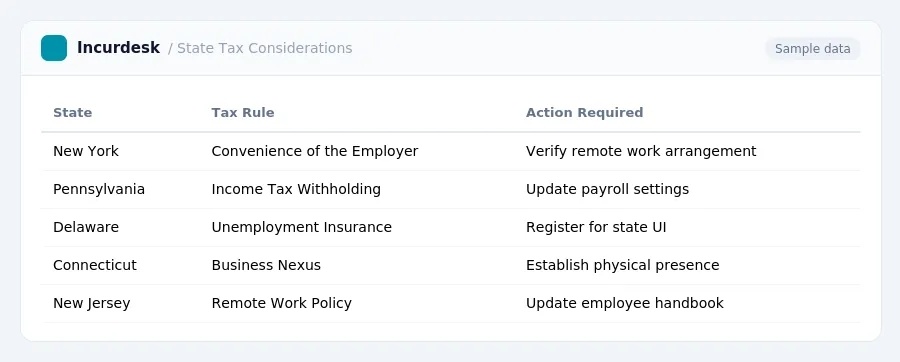
- Some states, such as New York, Pennsylvania, Delaware, Connecticut, and New Jersey, may tax income based on where the employee physically performs the work, rather than their employer's state.
- The "convenience of the employer" rule can apply, allowing the employer's state to tax income even if the employee works remotely elsewhere, unless the remote work was required by the employer.
- Rules for state income tax withholding, unemployment insurance, and establishing a business presence (nexus) vary significantly by state.
- The "convenience of the employer" rule is enforced by a specific set of states and can have different interpretations and exceptions.
- State laws dictate when final wages must be paid to employees upon termination or resignation.
- State workforce agencies administer the WOTC (Work Opportunity Tax Credit) process, and deadlines may have state-specific nuances in their implementation.
When reimbursing temporary tax season staff, consider the following:
- Check the specific state laws and regulations that apply to your business and employees.
- Understand the "convenience of the employer" rule and its implications for your business.
- Verify the deadlines for paying final wages to employees upon termination or resignation.
- Consult with a tax professional or attorney to ensure compliance with all applicable state laws and regulations.
Record-Keeping and Compliance Requirements for Reimbursing Temporary Tax Season Staff
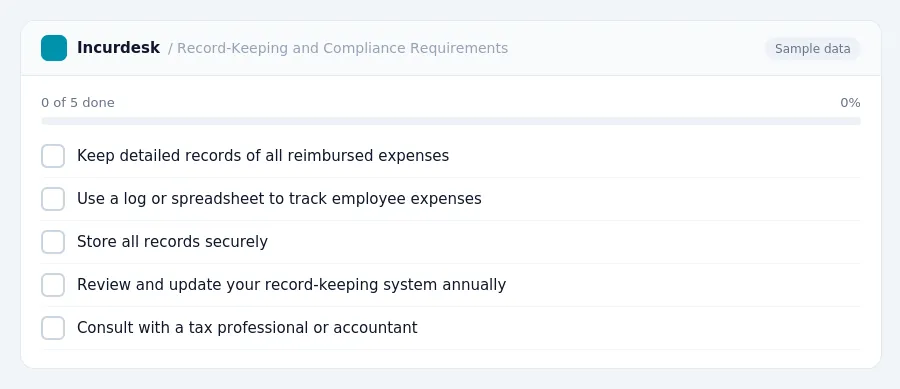
When it comes to reimbursing temporary tax season staff, accurate record-keeping and compliance are crucial to avoid any issues with the IRS. To ensure you're meeting these requirements, follow these guidelines:
- Keep detailed records of all reimbursed expenses, including receipts, invoices, and explanations of the business purpose for each expense.
- Use a log or spreadsheet to track employee expenses, including dates, locations, and descriptions of the expenses.
- Store all records securely, either electronically or in a locked file cabinet.
- Make sure to review and update your record-keeping system annually to ensure it's accurate and compliant with any changes in IRS regulations.
To ensure compliance, consider the following:
- Review the IRS's requirements for record-keeping and compliance to ensure you're meeting all necessary standards.
- Consult with a tax professional or accountant if you're unsure about any aspect of record-keeping or compliance.
- Keep records for at least three years in case of an audit or inquiry by the IRS.
Remember, accurate record-keeping and compliance are key to avoiding any issues with the IRS and ensuring your business is in good standing.
Keeping this simple: Incurdesk keeps receipts and approvals in one place, which makes a written policy easier to follow. It is built for small accounting teams. Try it free.
Stop losing 4+ hours a week
30-day free trial · No credit card · Setup in 15 minutes