Field Testing Costs: Billable or Absorbed
A practical, data-backed guide to controlling costs and automating expense workflows.
For small engineering businesses, accurately tracking and documenting field testing expenses is crucial for accurate cost allocation and client proposals. Understanding the rules and best practices for billing clients for field testing expenses is essential. Knowing which costs are directly billable, which might be absorbed as overhead, and how to accurately track and document these expenses for tax and client purposes is vital. Engineers can ensure that their bills are accurate by varying the rate of field testing expenses based on the location, duration, and type of test conducted. For the bigger picture, see our guide to engineering expense management for under $10/user (2026).
When to Absorb Field Testing Expenses as Overhead
Engineering firms often face the challenge of determining when to absorb field testing expenses as overhead versus direct labor costs. The key to making this decision is to consider the Engineering Firm Overhead rate, which is typically 1.61 times the loaded labor rate.
For engineering firms, the loaded labor rate is usually the average hourly rate of the engineer or technician performing the field test. To calculate the Engineering Firm Overhead rate, multiply the loaded labor rate by 2.61.
For example, if the loaded labor rate is $100 per hour and the Engineering Firm Overhead rate is 1.61, the overhead cost would be:
Engineering firms should absorb field testing expenses as overhead when:
- The total cost of the field test is $1,000 or more.
- The Engineering Firm Overhead rate is 1.61 or more.
Keeping this simple: Incurdesk turns submitted expenses into clean expense reports. It is built for small engineering teams. Try it free.
Here's the article:
Field Testing Costs: Billable or Absorbed
Here's a comparison of the two options:
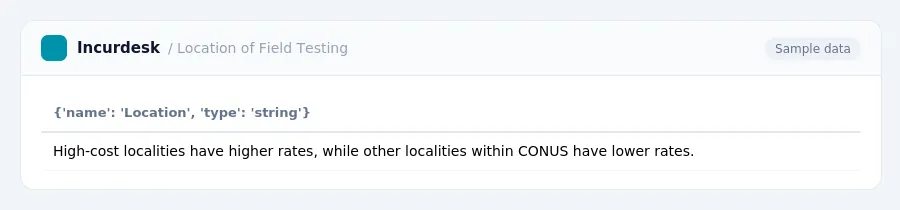
High-cost localities have higher rates, while other localities within CONUS have lower rates.
Engineers and office managers at small engineering businesses should track and document field testing expenses accurately, including:
- The location of the field testing
- The type of testing (e.g., inspection, measurement, etc.)
- The number of hours worked
- The rate of pay
- The rate of M&IE (meals and incidental expenses)
Tax rules, limits and rates change. Confirm current figures with the IRS or your accountant before you file.
Which Costs are Directly Billable?
When it comes to field testing costs, there are specific rules to follow to ensure accurate billing to clients.
- When to bill for field testing costs: Directly bill for field testing costs when the test results are used to improve the client's products or services, or when the test is performed at the client's location.
- Which costs are directly billable: Directly bill for costs that are directly related to the test, such as travel expenses, equipment rental, and consultant fees. These costs are typically reimbursed directly to the client.
- How to track and document field testing expenses: Accurately track and document field testing expenses by using a systematic process, including categorizing costs, recording hours worked, and providing detailed descriptions of each expense. This helps to ensure that costs are properly allocated and that records are available for tax and client purposes.
- When to absorb field testing expenses as overhead: Absorb field testing expenses as overhead when they do not meet the criteria for being directly billable.
How to Track and Document Field Testing Expenses
When it comes to tracking and documenting field testing expenses, it's essential to understand the rules and best practices. Here are some steps to follow:
- Use a standardized system to categorize and record expenses, such as a spreadsheet or a project management tool.
- Keep accurate and detailed records of all field testing expenses, including dates, locations, and descriptions of services provided.
- Use a consistent format for recording expenses, such as using a specific template or using a standard format for invoices and receipts.
- Make sure to include all relevant information, such as the name of the client, the type of testing, and the services provided.
- Keep records for at least 3-5 years in case of disputes or audits.
- Use a separate document or spreadsheet to track and record mileage, if applicable.
- Consider using a mileage log or a logbook to track hours worked and miles driven.
- Make sure to document the reason for each expense, including the specific services provided and the value of those services.
- Keep records of any correspondence with clients regarding field testing expenses, including emails, letters, and phone calls.
It's also important to note that some expenses may be considered overhead, such as travel costs or equipment rental fees. In these cases, it's essential to track and record these expenses separately to ensure they are properly allocated.
AI expense management for finance teams and whoever keeps the books. It checks every expense against your rules, approves the routine ones and chases missing receipts for you.
Try it free for 30 days →Stop losing 4+ hours a week
30-day free trial · No credit card · Setup in 15 minutes