Handling Missing Fuel Receipts from Drivers
A practical, data-backed guide to controlling costs and automating expense workflows.
In the realm of logistics expense management, it's a common conundrum for small businesses to navigate when drivers fail to provide fuel receipts for business expenses. One such alternative is using a fuel card, which can help drivers and businesses alike by providing a clear and auditable record of fuel purchases. For the bigger picture, see our guide to logistics expense management for under $10/user (2026). For a complete overview, see our expense management guide.
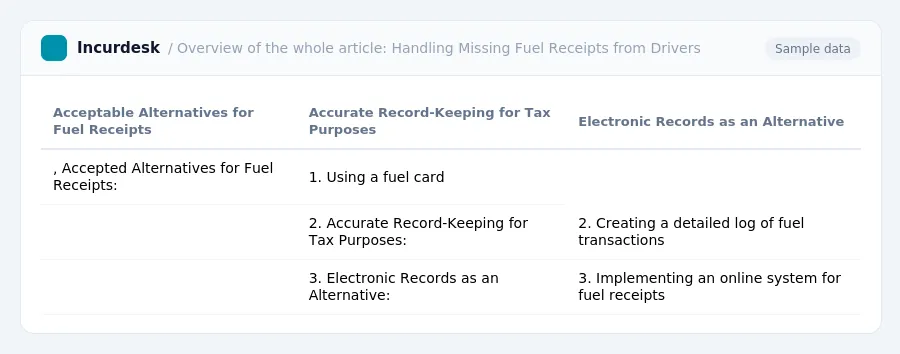
To ensure compliance, businesses must understand and adhere to these regulations.
This rate covers fuel, maintenance, and depreciation. To substantiate fuel costs, businesses must maintain a log showing date, destination, business purpose, and miles driven.
For vehicle use, a log is expected.
Businesses are not exempt from maintaining appropriate records for their underlying tax liability.
The rules in this guide
| Amount | Required | In Incurdesk |
|---|---|---|
| Above $75 | Itemised receipt | Checked on every expense |
| Above $250 | Written business purpose | Checked on every expense |
| Above $500 | Names of attendees | Checked on every expense |
| Above $5,000 | Senior sign-off; never auto-approved | Checked on every expense |
Each rule is checked on every expense by Incurdesk’s approval agent.
Acceptable Alternatives for Fuel Receipts
Businesses with drivers who do not provide fuel receipts for business expenses may face challenges in substantiating these costs for tax purposes.
However, this option has a limitation: actual fuel costs cannot be deducted separately. Instead, businesses can deduct a fixed amount for fuel used in business-related driving, which can be a more straightforward approach.
This approach provides a more transparent and reliable method for businesses to claim fuel expenses.
Ultimately, businesses should consult their state's fuel tax rates and local regulations to determine the most suitable method for substantiating fuel costs.
If a driver does not provide a fuel receipt, the business can use the following acceptable alternatives to substantiate fuel costs:
- Keep a log of fuel purchases, including the date, amount, and type of fuel purchased
- Use a fuel card or a credit card that records fuel purchases
- Keep a record of fuel receipts from other sources, such as a bank statement or a receipt from a fuel dealer
- Interest on the unpaid fuel costs
Accurate Record-Keeping for Tax Purposes
Businesses should keep records for three years from the date they filed their return. Employment tax records should be kept for at least four years. Asset records should be kept for the life of the asset plus three years.
To ensure accurate record-keeping, drivers should submit fuel receipts that are:
- Accurate and complete, including the date, type of fuel, and amount purchased
- Notarized or stamped if required by law
- Signed by the driver or their representative
- Notarized or stamped if required by law
If a driver is unable to provide a fuel receipt, they can:
- Use a fuel card or other electronic alternative
- Submit a written explanation for the lack of a receipt, along with supporting documentation (e.g. bank statement, receipt from a gas station)
- business necessity, equipment failure)
- Revise the business's tax return to reflect the missing receipts
- Request additional documentation to support the missing receipts
Electronic Records as an Alternative
For small logistics businesses, managing fuel receipts can be a challenge when drivers do not provide them. Fortunately, there are alternative ways to substantiate fuel costs and ensure accurate record-keeping for tax purposes.
One acceptable alternative is to use digital records. These can be created using electronic methods, such as scanning receipts or using an accounting software. To create a digital record, the payee (the business or individual providing the fuel) must clearly identify the payee, amount, proof of payment, date incurred, and a description of the business purpose. For example:
- Payee: Fuel Supplier
- Proof of Payment: Receipt attached to email
- Date Incurred: 2023-02-15
- Business Purpose: Business Use of Vehicle
Digital records must meet the same principles as hard copy records. They must be organized in a logical and consistent manner, and must include all required information. Electronic records are acceptable if they meet the same criteria as hard copy records, and can be used to support business expenses.
In addition to digital records, some businesses may also use online payment platforms or accounting software that allow them to store and manage fuel receipts electronically. These platforms often provide a secure and convenient way to store and retrieve digital records, making it easier to ensure compliance with tax regulations.
Tax rules, limits and rates change. Confirm current figures with the IRS or your accountant before you file.
Keeping this simple: Incurdesk lets your team snap a photo of a receipt and fills in the details for you. It is built for small logistics teams. Try it free.
AI expense management for finance teams and whoever keeps the books. It checks every expense against your rules, approves the routine ones and chases missing receipts for you.
Try it free for 30 days →Stop losing 4+ hours a week
30-day free trial · No credit card · Setup in 15 minutes