Last-Mile Delivery Driver Mileage Reimbursement
A practical, data-backed guide to controlling costs and automating expense workflows.
To ensure accurate reimbursement, it's essential to keep a record of miles driven, including dates, routes, and vehicle information. For the bigger picture, see our guide to logistics expense management for under $10/user (2026). For a complete overview, see our expense management guide.
Applicable Rates and Limitations
These rates are based on the actual miles driven by employees for business purposes, not on their personal driving habits.
This rate applies to miles driven for business purposes, such as transporting goods or packages for the business. However, this rate may vary depending on the state or country where the mileage is driven.
It's essential to check the specific rate applicable to your business in your state or country, as these rates can change annually. Additionally, you should also consider any local or state regulations that may impact your mileage reimbursement.
The rules in this guide
| Amount | Required | In Incurdesk |
|---|---|---|
| Above $75 | Itemised receipt | Checked on every expense |
| Above $250 | Written business purpose | Checked on every expense |
| Above $500 | Names of attendees | Checked on every expense |
| Above $5,000 | Senior sign-off; never auto-approved | Checked on every expense |
Each rule is checked on every expense by Incurdesk’s approval agent.
Common Pitfalls and Challenges
The last-mile delivery driver's reimbursement process can be complex, especially for small logistics businesses with limited resources. One common pitfall is underestimating mileage, leading to incorrect reimbursement.
Another challenge is accurately tracking mileage. Without proper records, it's easy to misclassify business mileage as personal use, leading to incorrect reimbursement. This can be particularly problematic if employees start using company vehicles for personal errands.
To avoid these pitfalls, businesses should establish clear reimbursement policies and procedures, and ensure accurate records are kept throughout the year. This includes maintaining a log of all business-related mileage, including trips to and from customers, as well as any additional business-related activities.
Record-Keeping and Compliance
To ensure accurate reimbursement and compliance, small logistics businesses need to maintain proper records. Here's what you need to know:
- Keep a log of all business mileage, including dates, routes, and destinations.
- Use a logbook or mobile device with a reliable GPS and note-taking app.
- Record the type of vehicle, make, model, and license plate number.
- Include the driver's name, license number, and hours worked.
- Attach a copy of the log to your tax return, along with any supporting documentation.
- Consider consulting with an accountant or tax professional to ensure accuracy and compliance.
Tax Benefits and Options
Armed Forces on active duty moving due to a permanent change of station. Employers with accountable plans must provide documentation to employees showing the business purpose of the trip and the actual business use of the vehicle.
This plan requires employees to keep records showing the actual business use of the vehicle and the amount of mileage reimbursed.
State-Specific Regulations and Considerations
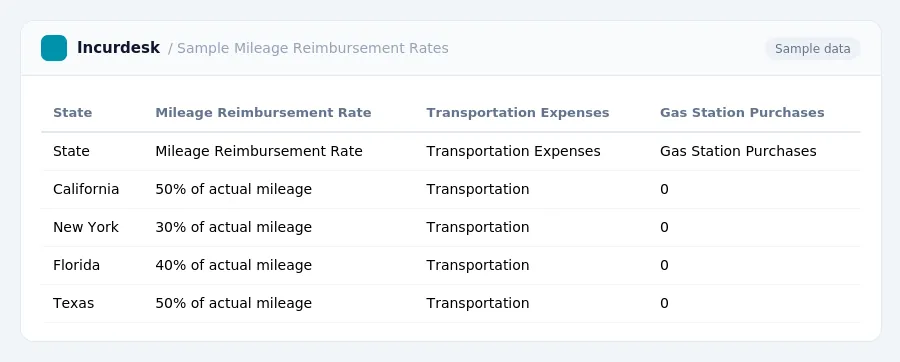
For example, some states have laws that exempt certain types of business use, such as gas station purchases or meals, from mileage reimbursement. Others have rules that limit the amount of reimbursement for certain types of expenses, such as mileage for transporting hazardous materials.
It's essential to check the specific tax laws in your state or country to determine the most accurate reimbursement rates. You can check with your state's revenue department or tax authority to find out if there are any changes to the mileage reimbursement rate or rules that may apply to your business.
Additionally, some states have laws that require businesses to keep detailed records of their mileage and expenses, including receipts and invoices. This is to ensure compliance with tax laws and to provide support in case of audits.
Tax rules, limits and rates change. Confirm current figures with the IRS or your accountant before you file.
Keeping this simple: Incurdesk keeps receipts and approvals together, so you know exactly what to reimburse. It is built for small logistics teams. Try it free.
AI expense management for finance teams and whoever keeps the books. It checks every expense against your rules, approves the routine ones and chases missing receipts for you.
Try it free for 30 days →Stop losing 4+ hours a week
30-day free trial · No credit card · Setup in 15 minutes