Multi-Currency Expenses on International Engagements
A practical, data-backed guide to controlling costs and automating expense workflows.
The complexities of managing international consulting expenses can be daunting, especially for small consulting businesses. As you navigate the intricacies of tax reporting and foreign financial accounts, it's essential to understand the thresholds for reporting such transactions. The threshold for reporting foreign financial accounts varies, but generally, transactions exceeding $10,000 in a year are subject to reporting requirements. This means that even small consulting businesses with international engagements may need to report these expenses. For the bigger picture, see our guide to consulting expense management for under $10/user (2026). For a complete overview, see our expense management guide.
Multi-Currency Expenses on International Engagements
For international engagements, it is essential to understand the tax and reporting implications of handling expenses in multiple currencies.
When conducting international projects, businesses must report foreign financial accounts. The threshold for reporting foreign financial accounts is typically 100,000, although this may vary depending on the provider and the specific project. To report foreign financial accounts, businesses must submit a foreign account report (FAR) to the relevant tax authority.
Currency gains and losses are treated differently for tax purposes. However, if a business has a net foreign exchange loss, it can offset against income from other countries.
To avoid this, businesses can consider using a tax-efficient transfer option, such as a transfer to a tax haven or a transfer that is less than the threshold.
The rules in this guide
| Amount | Required | In Incurdesk |
|---|---|---|
| Above $75 | Itemised receipt | Checked on every expense |
| Above $150 | Written business purpose | Checked on every expense |
| Above $300 | Names of attendees | Checked on every expense |
| Above $5,000 | Senior sign-off; never auto-approved | Checked on every expense |
Each rule is checked on every expense by Incurdesk’s approval agent.
Understanding Foreign Financial Account Reporting Requirements
Here are the key facts to keep in mind:
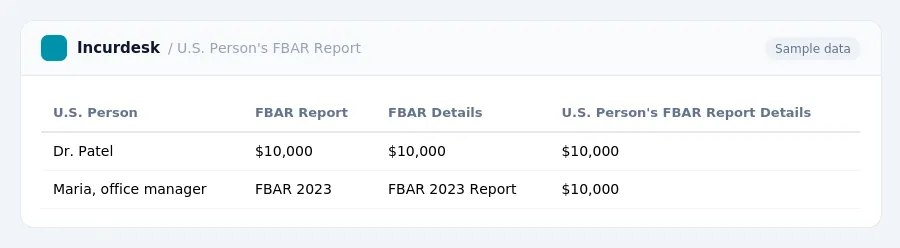
- A U.S. person must file an FBAR if the aggregate value of all foreign financial accounts exceeds $10,000 at any single time during the calendar year.
- FATCA covers a broad range of assets, including foreign bank accounts, brokerage accounts, stocks, bonds, mutual funds, hedge funds, private equity, ownership in foreign partnerships or corporations, foreign life insurance with cash value, and foreign pension plans.
- Form 8938 is a separate reporting requirement, and it's not a replacement for the FBAR obligation. Transfers funded by U.S. bank account withdrawals, U.S.-issued debit cards, or credit cards are exempt from the remittance tax.
- All foreign income and expenses must be converted to U.S.
Gaining Tax Benefits from Currency Gains and Losses
Multi-Currency Expenses on International Engagements
One key aspect to consider is the threshold for reporting foreign financial accounts.
This reporting requirement is in place to ensure compliance with the Foreign Account Tax Compliance Act (FATCA).
When reporting foreign financial accounts, businesses must include the following information:
- The name of the foreign financial account
- The type of account (e.g., bank account, credit card account)
- The account number or other identifying information
- The amount of money held in the account
To report foreign financial accounts accurately, businesses must keep accurate records of their transactions, including:
- Dates and amounts of transactions
- The type of transactions (e.g., wire transfers, currency exchanges)
- The names and addresses of the individuals involved in the transactions
New Regulations Affecting International Money Transfers
The International Monetary Fund (IMF) and the Organisation for Economic Co-operation and Development (OECD) have introduced new regulations to address the complexities of cross-border transactions.
The OECD's Common Reporting Standard (CRS) requires financial institutions to report certain information about their customers' financial accounts, including foreign financial accounts. This means that consulting businesses must report their foreign financial transactions on a regular basis to the relevant authorities.
The Financial Action Task Force (FATF) has also issued guidance on the taxation of foreign-sourced income. According to the FATF, foreign-sourced income must be taxed in the country where it is earned, unless it is exempt from taxation. Consulting businesses must ensure that their foreign-sourced income is properly taxed and reported.
In terms of reporting thresholds, the International Monetary Fund (IMF) requires that financial institutions report certain transactions above a certain threshold. For example, the IMF requires that financial institutions report transactions exceeding $10 million in a calendar year. The threshold may vary depending on the institution and the type of transaction.
Consulting businesses must also comply with the rules of their country's tax authority. The tax authority may require them to report certain information, including foreign financial accounts and foreign-sourced income.
Managing Foreign Exchange Risks and Compliance
To ensure compliance, it's essential to manage foreign exchange risks effectively.
Here are some steps to help you manage foreign exchange risks and comply with reporting requirements:
- Know the thresholds: Foreign exchange bureaus must file Currency Transaction Reports (CTRs) for cash transactions exceeding $10,000 in a single business day. This means that if you have a project with more than 10,000 USD in cash, you'll need to report it on your CTR.
- Calculate exchange rates: To avoid exchange rate risks, you can use a hedging strategy to lock in exchange rates. You can use a reputable foreign exchange bureau to help you with this process.
- Monitor and report transactions
- Keep accurate records: Maintaining accurate and detailed records of all transactions, including receipts, invoices, and CTRs, is crucial for compliance and tax purposes.
- Consider working with a remittance transfer providerThis can help mitigate exchange rate risks and reduce your tax liability.
Tax rules, limits and rates change. Confirm current figures with the IRS or your accountant before you file.
Keeping this simple: Incurdesk turns submitted expenses into clean expense reports. It is built for small consulting teams. Try it free.
AI expense management for finance teams and whoever keeps the books. It checks every expense against your rules, approves the routine ones and chases missing receipts for you.
Try it free for 30 days →Stop losing 4+ hours a week
30-day free trial · No credit card · Setup in 15 minutes