Receipt Requirements Clients Expect from Consultants
A practical, data-backed guide to controlling costs and automating expense workflows.
Understanding client receipt requirements is essential for small consulting businesses to maintain professional relationships and ensure accurate record-keeping. Clients expect clear, detailed receipts that serve as proof of payment and provide sufficient information for their own accounting and tax purposes. Generally, records supporting tax returns should be kept for at least three years from the date the return was filed, or two years from the date the tax was paid, whichever is later. This period extends to six years if income exceeding 25% of gross income was omitted. Clients also expect receipts to include essential details about the services rendered, the amount paid, and the transaction date. To meet these expectations, small consulting businesses should ensure that their receipts are accurate, detailed, and up-to-date. By doing so, they can establish trust with their clients and maintain a positive reputation in the industry. For the bigger picture, see our guide to consulting expense management for under $10/user (2026). For a complete overview, see our expense management guide.
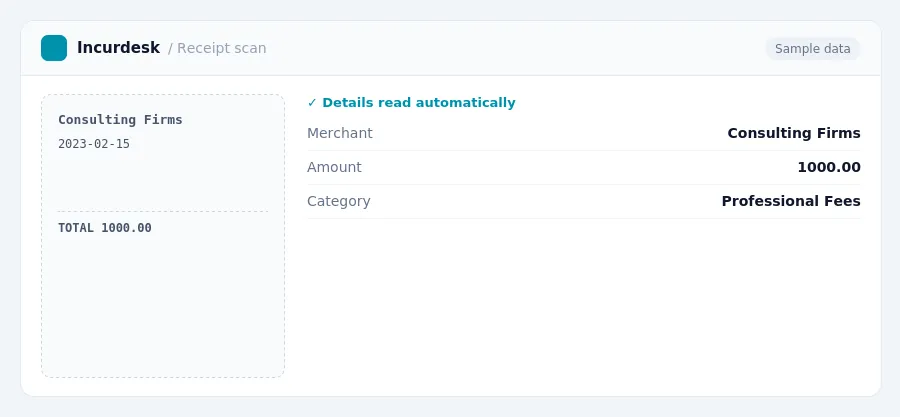
Receipt Requirements
- A receipt must include a header labeled "Receipt," the transaction date, a unique receipt number, seller details (business name, address, phone, email, tax ID), an itemized list of goods or services, the total amount paid, and the payment method.
- For business travel, transportation, and entertainment expenses, individual costs under $75 do not require a receipt, with some limitations. However, you still need a record of the amount, date, place, and business purpose.
- Lodging expenses always require a receipt, regardless of the amount.

The rules in this guide
| Amount | Required | In Incurdesk |
|---|---|---|
| Above $75 | Itemised receipt | Checked on every expense |
| Above $150 | Written business purpose | Checked on every expense |
| Above $300 | Names of attendees | Checked on every expense |
| Above $5,000 | Senior sign-off; never auto-approved | Checked on every expense |
Each rule is checked on every expense by Incurdesk’s approval agent.
Understanding Client Expectations
A receipt should contain the following information:
- A description of the services rendered
- The amount paid
- The date of payment
- The client's name and contact information
- A unique identifier for the transaction (such as a invoice number or client reference number)
- A statement indicating that the receipt is a receipt for the services rendered
Clients also expect receipts to be accurate and complete, and to reflect the exact amount paid. They should not include any additional information that is not necessary to fulfill their accounting and tax purposes.
This will provide sufficient time to maintain accurate and complete records, and to ensure compliance with tax laws and regulations.
Business Expense Documentation
These records must prove the amount, date, place (for travel and entertainment), and business purpose of each expense. Here are specific guidelines for documenting various business expenses:
- Records must show the amount (including tax and tip), date, place (restaurant name and location), business relationship (attendees' names, titles, company), and business purpose (what was discussed or conducted).
- A log with date, destination, and purpose is required.
- Documents for expenses should identify the payee, amount paid, proof of payment, date incurred, and include a description of the item or service that shows it was for a business expense.
- Fees for legal, accounting, and consulting services are key expense categories for Schedule C filers that require receipt documentation.
Record-Keeping Best Practices
An invoice is a request for payment issued before payment, while a receipt confirms that payment has been received. Many businesses issue both for clear record-keeping.
General Guidelines
- Keep records of all invoices issued to clients, including date, amount, and payment terms.
- Use a separate record for each transaction to maintain accuracy and avoid confusion.
- Consider using a standard format for invoices and receipts to ensure consistency.
- Ensure that all records, including invoices and receipts, are up-to-date and easily accessible.
- Keep records of payments in a secure and organized manner.
- Consider using a cloud-based document management system to store and access records remotely.
Tax Compliance Requirements
Tax Compliance Requirements
Sales tax requirements and rates vary significantly by state and locality. Consultants must ensure they are correctly applying and collecting sales tax where applicable, which may require specific information on invoices and receipts. This includes understanding the state's sales tax rate, exemption thresholds, and any applicable tax holidays or exemptions.
Tax rules, limits and rates change. Confirm current figures with the IRS or your accountant before you file.
Keeping this simple: Incurdesk lets your team snap a photo of a receipt and fills in the details for you. It is built for small consulting teams. Try it free.
AI expense management for finance teams and whoever keeps the books. It checks every expense against your rules, approves the routine ones and chases missing receipts for you.
Try it free for 30 days →Stop losing 4+ hours a week
30-day free trial · No credit card · Setup in 15 minutes