Safety Harness and Fall Protection Expense Policy
A practical, data-backed guide to controlling costs and automating expense workflows.
For small roofing contractors, ensuring compliance with OSHA regulations is crucial for maintaining a safe working environment. To avoid costly fines and injuries, it is essential to understand the specific requirements for fall protection, including trigger heights and required systems for different roof slopes. Additionally, the use and maintenance of safety equipment, such as harnesses and lanyards, must be properly documented in the expense management software. For the bigger picture, see our guide to roofing contractors expense management software. For a complete overview, see our expense management guide.
Safety Harness and Fall Protection Expense Policy
Fall protection is a critical aspect of workplace safety, and it's essential for small roofing contractors like yours to understand the regulations and guidelines. As per OSHA (2026), fall protection is required for any work performed at 6 feet or more above a lower level in construction.
For steep-slope roofs (greater than a 4:12 pitch), compliant systems include guardrail systems, safety nets, or personal fall arrest systems (PFAS). Warning lines are not permitted. To meet the requirements, you must have a guardrail system that meets the following standards:
- The guardrail must be at least 36 inches high and have a minimum clearance of 4 inches below the lowest point of the roof.
- The guardrail must be installed at a distance of at least 3 feet from the edge of the roof.
- The guardrail must be designed to distribute the weight of a single person evenly.
For low-slope roofs (4:12 pitch or less), acceptable fall protection includes guardrail systems, safety net systems, PFAS, or a warning line system combined with a safety monitor.
Each anchorage for a PFAS must support 5,000 pounds per employee attached, or be designed and used as part of a complete system with a safety factor of at least two under a qualified person. Single-person anchors serve one worker each.
Additionally, fall protection is required at all times for skylights. These must be covered with a cover capable of supporting twice the weight of workers, equipment, and materials, or be surrounded by a guardrail system.
The rules in this guide
| Amount | Required | In Incurdesk |
|---|---|---|
| Above $75 | Itemised receipt | Checked on every expense |
| Above $250 | Written business purpose | Checked on every expense |
| Above $500 | Names of attendees | Checked on every expense |
| Above $2,500 | Senior sign-off; never auto-approved | Checked on every expense |
Each rule is checked on every expense by Incurdesk’s approval agent.
OSHA Regulations for Fall Protection
A serious OSHA violation can result in a fine of up to $16,550, while a willful or repeat violation can reach $165,514.
To ensure compliance, it is essential to understand the specific regulations for fall protection in your industry.
In the United States, the Occupational Safety and Health Administration (OSHA) sets standards for fall protection on roofs. According to OSHA, the minimum fall protection requirements for roof work are as follows:
- Roof slopes with a vertical drop of 30 feet or more require a fall protection system with a trigger height of at least 10 feet.
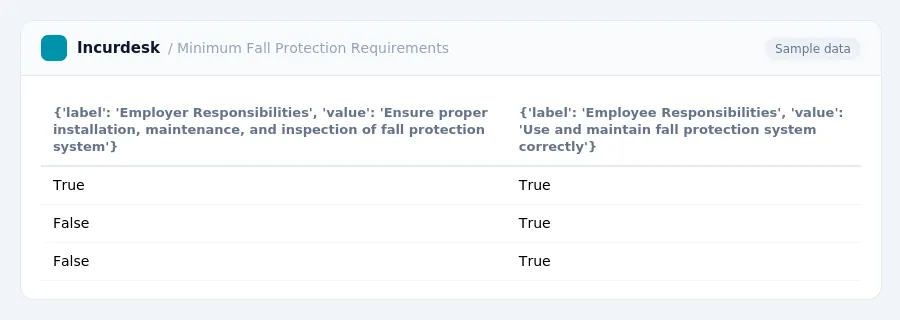
When implementing a fall protection system, it is crucial to ensure that the system is properly installed, maintained, and inspected regularly. The employer must also provide training to employees on the use and maintenance of the fall protection system.
Additionally, employers must maintain accurate records of the fall protection system, including the installation, maintenance, and inspection of the system, as well as any training provided to employees. Failure to comply with these regulations can result in serious consequences, including fines and penalties.
Equipment Use and Maintenance
Employers must provide fall protection training that employees can understand, and maintain written records of this training. The training should cover the principles of fall protection, the importance of personal protective equipment (PPE), and the proper use of fall protection systems.
The training program should include:
- A clear explanation of the hazards associated with falls from heights
- An overview of the different types of fall protection systems, such as lanyards, harnesses, and anchors
- Instructions on how to properly use each system
- Examples of how to identify and mitigate fall hazards
- A review of the employer's fall protection policy and procedures
Employers must also maintain written records of the training program, including:
- The training program itself
- The training materials used
- The training participants
- Any evaluations or assessments of the training program
Tax Implications for Safety Equipment
As a small roofing contractor, you are required to report the purchase and installation of safety equipment as a business expense on your tax return. The IRS allows you to deduct the cost of safety equipment, such as hard hats, steel-toe boots, safety glasses, and high-visibility vests, as a business expense.
This includes the cost of equipment, as well as the installation and testing of the equipment.
It is essential to keep accurate records of the purchase and installation of safety equipment, including receipts, invoices, and maintenance records. This will help you to ensure that you are taking advantage of the tax deductions available to you and that you are complying with the IRS regulations.
Record Keeping and Reporting
For small roofing contractors, keeping accurate records is crucial for compliance with OSHA regulations and tax implications for safety equipment purchases. Here's what you need to do:
- Keep a record of all fall protection equipment, including harnesses, lanyards, and gloves, with the date of purchase and a description of the equipment.
- Maintain a log of all fall protection training provided to employees, including dates, topics covered, and training providers.
- Document all inspections and audits conducted by OSHA, including dates, times, and findings.
- Keep a record of any maintenance or repairs performed on fall protection equipment, including dates, times, and methods used.
- When submitting tax forms, you may need to provide documentation of the cost of fall protection equipment, such as receipts or invoices.
- Keep records of all communication with employees regarding fall protection policies and procedures, including dates, times, and details of conversations.
- When reporting to OSHA, you will need to provide a detailed description of your fall protection program, including equipment usage and maintenance records.
- Keep records of any fines or penalties paid to OSHA for non-compliance with fall protection regulations.
- Keep a record of any employee disciplinary actions taken for non-compliance with fall protection regulations.
Tax rules, limits and rates change. Confirm current figures with the IRS or your accountant before you file.
Keeping this simple: Incurdesk keeps receipts and approvals in one place, which makes a written policy easier to follow. It is built for small roofing contractor teams. Try it free.
AI expense management for finance teams and whoever keeps the books. It checks every expense against your rules, approves the routine ones and chases missing receipts for you.
Try it free for 30 days →Stop losing 4+ hours a week
30-day free trial · No credit card · Setup in 15 minutes