Subcontractor Cost Tracking on IT Engagements
A practical, data-backed guide to controlling costs and automating expense workflows.
To accurately track and deduct subcontractor costs, small IT consulting businesses need to understand what expenses are deductible and how to properly record these costs. This involves identifying legitimate subcontractor payments as ordinary and necessary business expenses, which are generally 100% deductible against business income for 2026. To manage expense management for IT consulting, businesses should keep accurate records of subcontractor payments, including receipts, invoices, and payment receipts. This will help prevent financial miscalculations and potential penalties, ensuring compliance with tax laws and regulations. For a complete overview, see our expense management guide.
Tag every case to a subcontractor
If you're a small IT consulting business, accurately tracking subcontractor costs is crucial for ensuring accurate project profitability and tax compliance. To tag every case to a subcontractor, follow these steps:
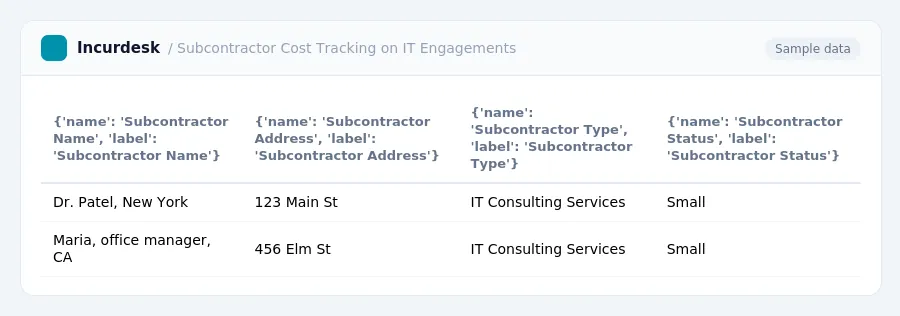
* When a subcontractor provides a receipt for expenses they incurred, repaying the exact amount shown on the receipt can keep that reimbursement off their 1099. This means that if supplies are included in their price without separate receipts, the entire amount counts as their pay. * When a subcontractor is similarly situated to you, meaning they provide the same services under the same contract, they must share the prime contractor's applicable small-business program status and be small under the assigned NAICS code. * To tag a subcontractor, simply attach the following information to the relevant project file or document: + The subcontractor's name and address + The subcontractor's tax ID number (if available) + The amount of payment made to the subcontractor + The date of payment
The rules in this guide
| Amount | Required | In Incurdesk |
|---|---|---|
| Above $75 | Itemised receipt | Checked on every expense |
| Above $250 | Written business purpose | Checked on every expense |
| Above $500 | Names of attendees | Checked on every expense |
| Above $5,000 | Senior sign-off; never auto-approved | Checked on every expense |
Each rule is checked on every expense by Incurdesk’s approval agent.
Identify subcontractor costs to be deductible
Here is the article:
- Identify subcontractor costs to be deductible
- Understand the proper methods for recording subcontractor costs
- Track subcontractor costs accurately
- Determine reporting requirements for 1099-NEC forms
Identify subcontractor costs to be deductible
This means that all subcontractor payments, including those made for IT engagements, can be deducted from your business income.
To ensure you're deducting these costs correctly, it's essential to keep accurate records. This includes:
- Receipts for payment confirmations
- Invoices for subcontractor services
- Bank statements showing payment receipts
- Any other documentation that supports the legitimacy of the subcontractor payment
It's also crucial to follow the rules for deducting business expenses, including subcontractor payments. For 2026, legitimate subcontractor payments are considered ordinary and necessary business expenses and are generally 100% deductible against business income.
Understand the proper methods for recording subcontractor costs
Here is the article:
When tracking subcontractor costs, it's essential to follow specific guidelines to ensure accurate financial reporting and compliance. Here are the steps to follow:
- Identify subcontractor costs: Start by identifying all subcontractor costs incurred during the engagement, including labor, materials, equipment, and travel expenses. Make sure to categorize these costs correctly, such as by type (e.g., engineering, testing) or service (e.g., design, implementation).
- Record subcontractor costs accurately: Use a standardized system to record subcontractor costs, such as a separate ledger or a spreadsheet. Ensure that all costs are accurately documented, including dates, amounts, and descriptions.
- Use proper documentation: Keep detailed records of subcontractor payments, including invoices, receipts, and payment records. This will help you track payments and ensure that you can claim these costs on your tax return.
- Maintain accurate records: Keep all records of subcontractor payments, including payments to subcontractors, invoices, and payments to third-party vendors. This will help you accurately calculate your business expenses and taxes.
- Consider using a third-party vendor: If you're using a third-party vendor to provide services, such as design or implementation, you may need to track their payments separately. Consult with your accountant or bookkeeper to ensure you're tracking these costs accurately.
Track subcontractor costs accurately
It is essential to track subcontractor costs as a distinct line item in estimates and job cost reports, separate from direct labor and materials, to accurately determine project profitability. This is because subcontractor costs are often necessary to complete the project, and excluding them from the overall cost can lead to inaccurate project profitability.
Tracking subcontractor costs is crucial for ensuring compliance with tax laws. This means that you can deduct all subcontractor payments as a business expense on your tax return.
To track subcontractor costs accurately, follow these steps:
- Create a separate account or line item in your job cost reports to track subcontractor costs.
- Record subcontractor payments as soon as possible after they are made, but no later than 12 months from the end of the tax year.
- Use a detailed and accurate record-keeping system to ensure that subcontractor costs are correctly identified and documented.
- Keep records of subcontractor payments for at least three years in case of an audit.
- Consider using a spreadsheet or accounting software to track subcontractor costs and make it easier to analyze and report on.
By tracking subcontractor costs accurately, you can ensure that you are taking advantage of all the deductions available to you and that your project profitability is accurately reflected in your financial reports.
Determine reporting requirements for 1099-NEC forms
Here is the article on "Determine reporting requirements for 1099-NEC forms":
- This is an increase from the previous $600 threshold.
- For payments made in 2026, 1099-NEC forms are due to the IRS and the contractor by February 1, 2027. This is because January 31, 2027, falls on a Sunday.
- Starting in 2027, the $2,000 1099-NEC threshold will be adjusted annually for inflation.
- Payments made to contractors via credit card or payment apps like PayPal are generally not reported on a 1099-NEC by the business, as the card company or app provider reports them.
Tax rules, limits and rates change. Confirm current figures with the IRS or your accountant before you file.
Keeping this simple: Incurdesk turns submitted expenses into clean expense reports. It is built for small it consulting teams. Try it free.
AI expense management for finance teams and whoever keeps the books. It checks every expense against your rules, approves the routine ones and chases missing receipts for you.
Try it free for 30 days →Stop losing 4+ hours a week
30-day free trial · No credit card · Setup in 15 minutes