Subcontractor Expense Pass-Through Rules
A practical, data-backed guide to controlling costs and automating expense workflows.
To qualify for pass-through status, subcontractors must be independent contractors, not employees, and meet specific requirements. The IRS allows eligible non-corporate owners to deduct up to 20% of their qualified business income from a pass-through business, as long as the pass-through business is operated for profit and has a sole proprietorship or S corporation structure. For the bigger picture, see our guide to consulting expense management for under $10/user (2026). For a complete overview, see our expense management guide.
Best Practices for Pass-Through Businesses
- When paying independent contractors with subcontractor expense reimbursements, issue a Form 1099-NEC to those contractors if they have received $2,000 or more in payments during the year (2026). - Businesses with contractors must use an "accountable plan" to exclude reimbursements from a contractor's taxable income. - To comply with the IRS, businesses must keep accurate records of subcontractor expenses, including receipts, invoices, and bank statements. - Use the following steps to set up an accountable plan: 1. 2. Create a detailed budget for subcontractor expenses and track actual expenses. 3. Keep accurate records and calculations to support the deduction. 4. Consult with a tax professional or accountant to ensure compliance and accuracy. - To maintain good relationships with clients and contractors, communicate clearly about subcontractor expense reimbursements and ensure accuracy in all tax-related matters. - Consider implementing a regular review process to ensure compliance and accuracy in subcontractor expense reimbursement and tax reporting.
Keeping this simple: Incurdesk turns submitted expenses into clean expense reports. It is built for small consulting teams. Try it free.
Avoiding Penalties and Maintaining Good Relationships
When claiming subcontractor expenses, it's crucial to keep accurate records and follow the IRS regulations. This includes:
- Keeping records of subcontractor payments, including invoices and payment dates
- Keeping records of subcontractor work performed, including hours worked and materials provided
- Keeping records of subcontractor insurance, including liability and workers' compensation insurance
- Reporting subcontractor expenses on Schedule C (Form 1040), Part I, under the "Other Business Income" category
- Communicate clearly and transparently about subcontractor expenses and fees
- Provide regular updates on subcontractor expenses and fees
- Be transparent about the services provided and the fees charged
- Show appreciation for subcontractor work and contributions to the business
- Be willing to negotiate and compromise on subcontractor fees and services
Subcontractor Expense Pass-Through Rules
When a small consulting business has subcontractors, it's essential to follow the rules for passing through subcontractor expenses to accurate tax reporting and maintain good relationships with clients and contractors. Here are the key takeaways:
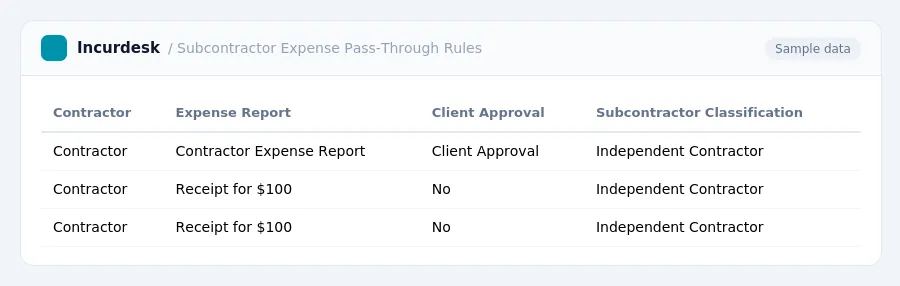
- Contractors must provide itemized receipts, detailed expense reports, and client approval for reimbursed costs. This ensures that the business can accurately claim the expenses on the tax return.
- While federal rules set a $2,000 threshold for 1099-NEC and 1099-MISC for 2026, some states may have different reporting thresholds. It's essential to check the specific requirements for your state and industry.
- To pass through subcontractor expenses, the business must meet certain criteria, including:
- The subcontractor must be an employee or independent contractor, not a partner or owner of the business.
- The business must provide documentation of the subcontractor's work, including itemized receipts and detailed expense reports.
- The subcontractor must have a written agreement with the business stating that the work will be done on a contract basis.
The rules in this guide
| Amount | Required | In Incurdesk |
|---|---|---|
| Above $75 | Itemised receipt | Checked on every expense |
| Above $150 | Written business purpose | Checked on every expense |
| Above $300 | Names of attendees | Checked on every expense |
| Above $5,000 | Senior sign-off; never auto-approved | Checked on every expense |
Each rule is checked on every expense by Incurdesk’s approval agent.
Understanding the IRS Regulations
Subcontractor Expense Pass-Through Rules
The IRS uses a common-law test to determine if a worker is an employee or an independent contractor. This test focuses on three key factors: behavioral control, financial control, and the type of relationship.
The IRS allows for an exception to the receipt requirement for non-lodging expenses under $75. To qualify for this exception, the following conditions must be met:
- The amount must be recorded
- The time, place, and business purpose must be recorded
- The worker must be in a business relationship with the client
The IRS business mileage rate for 2026 is 72.5 cents per mile from January 1 to June 30, and 76 cents per mile from July 1 to December 31.
When deducting subcontractor expenses, it is essential to understand the rules and regulations to avoid any potential penalties. Here are some key takeaways:
- Record the amount, time, place, and business purpose of each expense
- Keep accurate and detailed records for at least three years
- If you use a smartphone or other business-related equipment, you may be able to deduct the business use percentage of your phone bill
- Keep records of business-related expenses, such as travel and meals, even if you don't use them for business purposes
- If you are an eligible non-corporate owner, you can generally deduct up to 20% of your qualified business income from a pass-through business.
By following these guidelines, you can ensure accurate tax reporting and avoid any potential penalties when working with subcontractors.
Common Pitfalls and Solutions
Reimbursable expenses must be "ordinary" and "necessary" expenses, meaning they are common and accepted in the industry, and help the business function appropriately.
Some common pitfalls to avoid:
- Not tracking expenses in detail, which can lead to inaccurate deduction claims.
- Failing to categorize expenses correctly, which can result in incorrect deductions.
- Not keeping records for at least three years, which can make it difficult to prove business purpose and necessity.
- Not properly documenting business use of personal expenses, such as meals or travel, which can be considered deductions.
To avoid these pitfalls, it's essential to maintain accurate and detailed records of all business expenses, including receipts, invoices, and bank statements. This will help ensure that only eligible expenses are deducted, and that the business is meeting its tax obligations.
Tax rules, limits and rates change. Confirm current figures with the IRS or your accountant before you file.
AI expense management for finance teams and whoever keeps the books. It checks every expense against your rules, approves the routine ones and chases missing receipts for you.
Try it free for 30 days →Stop losing 4+ hours a week
30-day free trial · No credit card · Setup in 15 minutes