Tooling and Die Costs: Capital or Expense
A practical, data-backed guide to controlling costs and automating expense workflows.
For small manufacturing companies, determining whether tooling and die costs should be treated as a capital expenditure or an immediate expense is a crucial decision that can impact profitability, cash flow, and tax liability. The timing of accounting for these significant investments can vary, and it's essential to understand the benchmark percentage that is commonly accepted in the industry. A common benchmark is that tooling expenses can account for 20-30% of total production costs in CNC machining. For the bigger picture, see our guide to manufacturing expense management (2026 guide). For a complete overview, see our expense management guide.
When Tooling and Die Costs Are Expensed
Tooling and die costs can be either capitalized or expensed, depending on the business's financial situation and accounting standards.
- The tooling and die costs are related to the production of a specific product or batch.
- The business has a long-term production plan and expects to use the tooling and die for a significant amount of time.
In general, tooling and die costs are typically expensed, as they are incurred to produce specific products or batches. However, if you have a long-term production plan and expect to use the tooling and die for an extended period, it may be more beneficial to capitalize the costs and depreciate them over the expected useful life.
Keeping this simple: Incurdesk turns submitted expenses into clean expense reports. It is built for small manufacturing companies teams. Try it free.
Benefits of Tooling and Die Costs as a Capital Expenditure
Capitalizing tooling and die costs means recognizing them as assets on the balance sheet, which can provide long-term cost savings and value. However, this approach requires proper documentation, accounting, and compliance with financial regulations.
When tooling and die costs are capitalized, they are recorded as assets on the balance sheet, and the business can claim depreciation and amortization over their useful life.
On the other hand, expensing tooling and die costs means deducting them from gross profit in the current year, which can provide immediate cash flow benefits.
In general, tooling and die costs are best capitalized when they are expected to last for more than one year, and their value is expected to increase over time. Conversely, tooling and die costs are usually expensed when they are used for a specific period, such as for a single production run.
It's essential to consult with a financial advisor or accountant to determine the most suitable approach for your small manufacturing company. They can help you evaluate the costs, benefits, and compliance requirements for tooling and die expenses.
Tax rules, limits and rates change. Confirm current figures with the IRS or your accountant before you file.
Tooling and Die Costs: Capital or Expense
Tooling and die costs can be either capital expenditures or immediate expenses, and it's essential to understand this distinction for accurate financial reporting and tax optimization.
This is a significant investment, and its impact on a business's profitability, cash flow, and tax liability is substantial.
When deciding whether to treat tooling and die costs as capital expenditures or immediate expenses, consider the following guidelines:
- If the tooling and die costs are expected to last for 5 years or more, they are likely to be classified as capital expenditures.
- If the tooling and die costs are not recoverable through depreciation, they are likely to be classified as immediate expenses.
For small manufacturing companies, it's essential to comply with relevant laws and regulations. Department of the Treasury.
It's crucial to consult with a tax professional or accountant to determine the most advantageous method for your company.
The rules in this guide
| Amount | Required | In Incurdesk |
|---|---|---|
| Above $75 | Itemised receipt | Checked on every expense |
| Above $250 | Written business purpose | Checked on every expense |
| Above $500 | Names of attendees | Checked on every expense |
| Above $5,000 | Senior sign-off; never auto-approved | Checked on every expense |
Each rule is checked on every expense by Incurdesk’s approval agent.
Understanding Tooling and Die Costs
Capital Expenditure (CapEx)
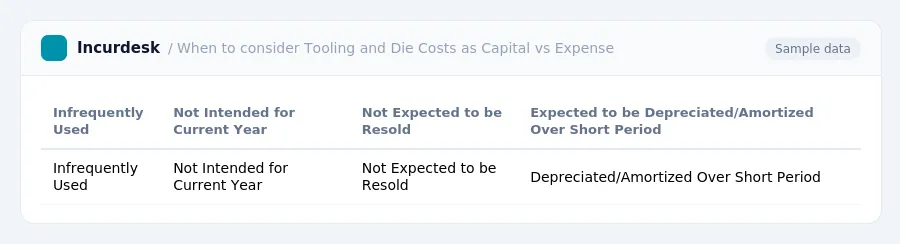
Tooling and die costs are typically considered capital expenditures when they are:
- Infrequently used or replaced
- Not intended to be used in the current production year
- Not expected to be resold or used in future production
- Not expected to be depreciated or amortized over a short period
This means that if you need to replace your tooling and die every 5 years, you would consider it a capital expenditure.
Immediate Expense
Tooling and die costs are typically considered immediate expenses when they are:
- Frequently used or replaced
This means that if you plan to use your tooling and die every year, you would consider it an immediate expense.
Benefits to Consider
- Capital Expenditure: reduces the risk of obsolescence, increases long-term profitability, and allows for more accurate depreciation calculations.
- Immediate Expense: may be used to reduce production costs, improve efficiency, and increase competitiveness.
It's essential to remember that the benchmark percentage of 20-30% of total production costs in CNC machining is just one benchmark, and you should use the specific context of your business to make a decision that aligns with your financial goals and strategies.
AI expense management for finance teams and whoever keeps the books. It checks every expense against your rules, approves the routine ones and chases missing receipts for you.
Try it free for 30 days →Stop losing 4+ hours a week
30-day free trial · No credit card · Setup in 15 minutes