Tracking Fuel Receipts Across a Truck Fleet
A practical, data-backed guide to controlling costs and automating expense workflows.
For many business owners and office managers, understanding the importance of fuel receipt tracking can vary, but it is essential to know the tax rates, record-keeping requirements, and common pitfalls that can arise. To manage logistics expense management for under $10/user (2026), it is recommended to establish a system that accurately records fuel purchases and follows IFTA guidelines. For a complete overview, see our expense management guide.
Track
Track Fuel Receipts Across a Truck Fleet
- Obtain a copy of the diesel fuel tax invoice and a gasoline tax invoice from the supplier. These documents will include the tax rates, which vary by gallon and year.
- Record the diesel fuel tax invoice as a fuel expense on the business's general ledger.
- Verify that the diesel fuel tax rate and gasoline tax rate are correctly applied to the business's fuel expenses.
- If the business uses alternative fuel, such as biodiesel or natural gas, record the corresponding fuel expense on the business's general ledger.
The rules in this guide
| Amount | Required | In Incurdesk |
|---|---|---|
| Above $75 | Itemised receipt | Checked on every expense |
| Above $250 | Written business purpose | Checked on every expense |
| Above $500 | Names of attendees | Checked on every expense |
| Above $5,000 | Senior sign-off; never auto-approved | Checked on every expense |
Each rule is checked on every expense by Incurdesk’s approval agent.
Record
Track
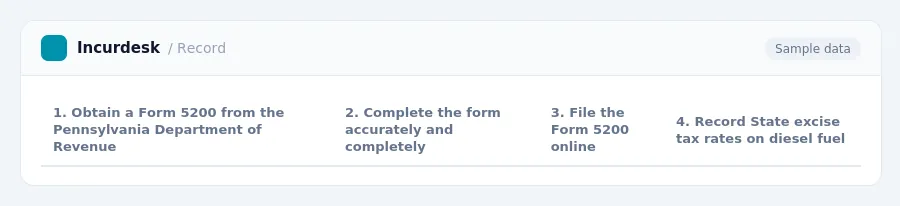
1. Obtain a Form 5200 from the Pennsylvania Department of Revenue, which is the required document for reporting fuel receipts. This form is available online or by mail upon request. 2. Complete the form accurately and completely, providing all required information, including the date, mileage, and cost of fuel. 3. 5. 6. File the Form 5200 online through the Pennsylvania Department of Revenue's website. 7. If you have any questions or concerns about reporting fuel receipts, contact the Pennsylvania Department of Revenue.
Record
State excise tax rates on diesel fuel vary significantly. California's rate can be as high as 97.9 cents per gallon in the fourth quarter of 2026, while some states like Oregon may have much lower rates. Diesel tax rates can change, so it's essential to check the rates in your state and local government website for the most up-to-date information.
Verify
Track Fuel Receipts Across a Truck Fleet
- Obtain a copy of the most recent fuel invoice from the trucking company that provided the fuel.
- Review the invoice to ensure that it includes the correct fuel type, quantity, and tax information.
- Attach the invoice to the truck's maintenance log or fuel receipt log.
- Record the fuel receipt in the truck's maintenance log or fuel receipt log, including the date, time, and location of the fueling event.
- Enter the fuel receipt into the company's accounting system, if applicable.
- If the fuel receipt meets the requirements, calculate the business use percentage and apply it to the total fuel cost to determine the business use tax liability.
- Compare the calculated business use tax liability to the amount of tax withheld from the fuel receipt to ensure accuracy.
- If the calculated business use tax liability exceeds the amount of tax withheld, calculate the excess tax and apply it to the fuel receipt.
Audit
The International Fuel Tax Agreement (IFTA) requires interstate carriers to report fuel purchases and miles driven in each jurisdiction quarterly.
To comply with IFTA, small logistics businesses must make quarterly fuel reports to the relevant authorities. The reports must include the date, mileage, and amount of fuel purchased, as well as the jurisdiction in which the fuel was purchased. The reports must be submitted to the Canada Revenue Agency (CRA) and the U.S. Customs and Border Protection (CBP).
It is essential to keep accurate records of fuel purchases and miles driven to ensure compliance with IFTA regulations. Small businesses should review their fuel receipts and mileage logs to ensure that they are meeting the requirements. If a business has purchased fuel in multiple jurisdictions, they must keep records of each purchase, including the date, mileage, and amount of fuel purchased.
In case of a discrepancy or issue with a fuel report, the business should contact the relevant authorities in a timely manner.
Document
For IFTA and tax purposes, fuel receipts must include the date of purchase, seller's name and address, gallons purchased, fuel type, vehicle number, purchaser's name, and price per gallon.
The format of the fuel receipt is typically as follows:
- Date of purchase: [date]
- Seller's name and address: [seller's name and address]
- Gallons purchased: [gallons]
- Fuel type: [fuel type]
- Vehicle number: [vehicle number]
- Purchaser's name: [purchaser's name]
- Price per gallon: [price per gallon]
For example, if a truck is purchased on January 1st and purchased 100 gallons of diesel fuel, the fuel receipt would include:
- Date of purchase: January 1st
- Gallons purchased: 100
- Fuel type: Diesel
- Vehicle number: [vehicle number]
- Purchaser's name: [purchaser's name]
It is also required to include the following information on the fuel receipt:
- The seller's and purchaser's names and addresses
- The gallons of fuel purchased
- The fuel type
- The vehicle number
- The purchaser's name
- The price per gallon
This information is necessary to comply with the Internal Revenue Code and the Motor Carrier Tax Act.
Tax rules, limits and rates change. Confirm current figures with the IRS or your accountant before you file.
Keeping this simple: Incurdesk lets your team snap a photo of a receipt and fills in the details for you. It is built for small logistics teams. Try it free.
AI expense management for finance teams and whoever keeps the books. It checks every expense against your rules, approves the routine ones and chases missing receipts for you.
Try it free for 30 days →Stop losing 4+ hours a week
30-day free trial · No credit card · Setup in 15 minutes