Tracking Paid Search Spend Managed for Clients
A practical, data-backed guide to controlling costs and automating expense workflows.
Understanding paid search spend management for clients is a crucial aspect of running a successful SEO agency. To accurately monitor, analyze, and report on the advertising budgets managed for their clients, it's essential to know what metrics to track and what tools to use. To maximize client ROI while staying compliant with regulations, such as the Federal Trade Commission's (FTC) guidelines on affiliate marketing and paid advertising, it's recommended to utilize expense management software specifically designed for tracking paid search spend. For the bigger picture, see our guide to seo agencies expense management software.
Tag every case to a dentist
To tag every case to a dentist, follow these steps:
- When tracking paid search spend, identify the dentist or dentist provider that will be managing the client's account. This may be a dentist specialist who has expertise in SEO or digital marketing, or a dentist who has been referred to the agency for their expertise.
- Ensure that the dentist is familiar with the client's specific needs and goals, and that they have been brought in to manage the account.
- When analyzing the client's paid search spend, make sure to track the dentist's input and decisions on bids, ad positions, and other campaign settings.
- Use the dentist's input to optimize the campaign for better ROI and patient results.
- When reporting the client's progress to the dentist, provide them with clear and concise metrics and data on the campaign's performance.
- If the dentist has specific recommendations or changes to make to the campaign, make sure to implement those changes and report back to the client.
- If the client is not satisfied with the dentist's performance or recommendations, have a plan in place to address those issues and improve the client's experience.
Track and analyze Paid Search Spend
Here is the article:
Track and Analyze Paid Search Spend
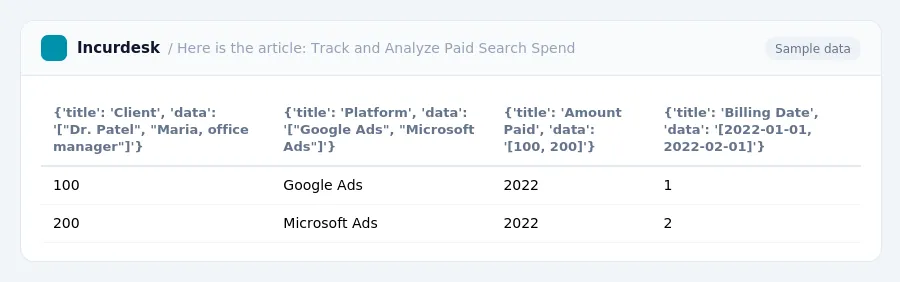
- Identify the paid search platforms used by your clients, such as Google Ads, Microsoft Ads, and others. Note down the platform, amount paid, and billing date for each campaign.
- Obtain all relevant invoices or receipts for each campaign, including business payment methods and the business purpose of the payment. This information is crucial for tracking expenses and ensuring compliance.
- Record the business purpose of each payment, as this is essential for calculating Return on Investment (ROI) and ensuring that costs are being accurately allocated.
- Use the CPA (Cost Per Acquisition) formula to calculate the cost per customer acquired or conversion achieved. This will help you understand the effectiveness of your campaigns and make data-driven decisions.
- Keep track of the number of new customers acquired or conversions achieved through each campaign. This will allow you to calculate the Return on Ad Spend (ROAS) and Return on Investment (ROI) for each campaign.
- Monitor the Quality Score for each campaign, as this can significantly impact the campaign's effectiveness. Check the Quality Score regularly to ensure that it is within the acceptable range.
- Keep a record of the Average Position and Conversion Rate for each campaign, as these metrics can also impact the campaign's effectiveness.
- Analyze the data from each campaign to identify trends, successes, and areas for improvement. Use this information to adjust your strategies and optimize campaign performance.
- Ensure that you are complying with all relevant regulations, including those related to tax and financial reporting. This includes accurately tracking and reporting expenses, and ensuring that clients are aware of the costs associated with their paid search campaigns.
Maximize Client ROI
Tracking paid search spend is a critical process that directly links ad spend to revenue for small to medium-sized SEO agency businesses. This process is essential for maximizing efficiency and ROI. Ad spend tracking involves monitoring, analyzing, and managing advertising budgets across all channels to optimize results. The systematic process involves regularly reviewing and updating ad spend data to ensure consistency and accuracy.
Manual tracking, such as logging into platforms or using spreadsheets, becomes inefficient with multiple channels. Automated tools consolidate data for real-time, cross-channel insights, providing valuable information for clients. These tools can help identify areas for improvement, optimize campaigns, and increase overall efficiency.
To maximize client ROI, it is essential to:
- Set clear and measurable goals for ad spend tracking
- Establish a regular review and update schedule
- Use data to inform campaign optimization and decision-making
- Continuously monitor and adjust ad spend to ensure alignment with business objectives
By implementing these steps, small to medium-sized SEO agency businesses can optimize their ad spend, increase efficiency, and ultimately drive better ROI for their clients.
Stay Compliant and Adaptable
As a small to medium-sized SEO agency, it's essential to ensure you're managing paid search spend for your clients in a way that's compliant with relevant regulations. Here are some key takeaways to help you stay on track:
- Make sure you're including a clear statement on the invoice, such as "Paid Search Management Services" and "Disclosed Fee: [X]".
- The Digital Advertising Alliance (DAA) has guidelines for transparency in online advertising, including paid search. Familiarize yourself with the DAA's "Opt-in Transparency" and "Data-Driven Decision-Making" principles.
- The General Data Protection Regulation (GDPR) applies to all businesses that handle personal data, including client data. Ensure you're implementing proper data protection measures, such as obtaining client consent and using secure data storage.
- Be aware of what constitutes deceptive advertising and take steps to avoid it.
- The DAA recommends that SEO agencies use transparent and descriptive ad formats, such as the "Expanded Text Link Definition" (ETL) or "Extended Text Link Definition" (ETLD). This helps clients understand the ad's content and intent.
- Regularly review and update your agency's policies and procedures to ensure compliance with evolving regulations. Consider consulting with a regulatory expert or seeking guidance from a professional association, such as the DAA.
Tax rules, limits and rates change. Confirm current figures with the IRS or your accountant before you file.
Keeping this simple: Incurdesk turns submitted expenses into clean expense reports. It is built for small seo agency teams. Try it free.
AI expense management for finance teams and whoever keeps the books. It checks every expense against your rules, approves the routine ones and chases missing receipts for you.
Try it free for 30 days →Stop losing 4+ hours a week
30-day free trial · No credit card · Setup in 15 minutes