
Vendor Rep Meal and Gift Expense Policies in Hospitals
A practical, data-backed guide to controlling costs and automating expense workflows.
As a small hospital business owner or office manager, you need clear guidelines on tax deductibility and compliance requirements for vendor meals and gifts. The IRS sets limits on these expenses, and state-specific regulations may also apply, making expense management for hospitals a complex issue.
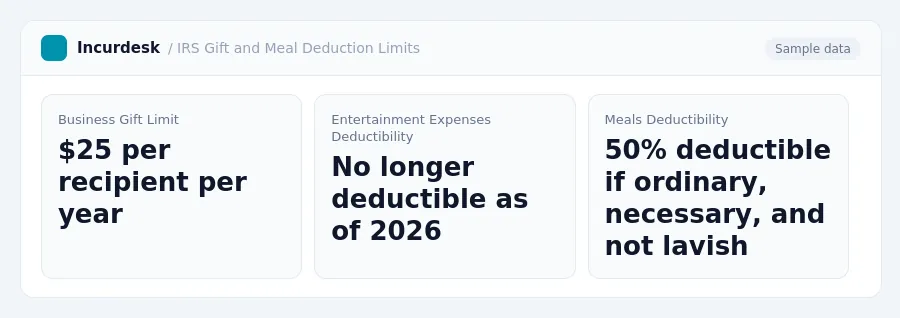
IRS Gift and Meal Deduction Limits
The IRS sets limits on the deductibility of business gifts and meals. Here are some key points to keep in mind:
Most business gifts are limited to $25 per recipient per year. This limit has been in place since 1962 and has not been indexed for inflation.
- Items given to a company for its general use are generally fully deductible.
- If the gift primarily benefits an individual, the $25 limit applies.
Most entertainment expenses, including tickets to sporting events, are no longer deductible as of 2026, even if business-related.
- However, if event tickets are given as a gift and the giver does not attend, they may be subject to the business gift limit.
For meals, the general rule is that most business meals are 50% deductible if they are:
- Ordinary
- Necessary
- Not lavish
- An employee or owner is present
The incidental expenses only deduction is $5 per day.
Compliance with State Regulations
When it comes to vendor meals and gifts, state regulations can vary significantly. For instance, in California, healthcare professionals (HCPs) are subject to a specific limit for meals provided by vendors. According to the State Agency, the annual limit for meals provided to HCPs in California should not exceed $250.
Here's how to ensure compliance with state regulations:
- Check the specific regulations in your state regarding vendor meals and gifts.
- Determine the limits for meals provided to healthcare professionals, if applicable.
- Keep accurate records of all vendor meals and gifts, including dates, amounts, and attendees.
- Ensure that all meals and gifts are reasonable and not lavish.
For example, if you're a hospital owner in California, you should be aware of the $250 annual limit for meals provided to HCPs. To comply, you could consider the following:
- Limit the number of meals provided to HCPs to avoid exceeding the $250 limit.
- Choose restaurants or venues that are within the reasonable expense limit.
- Keep accurate records of all meals provided, including receipts and attendees.
Remember, it's essential to stay informed about state regulations and ensure compliance to avoid any potential issues.
Vendor Meal and Gift Guidelines in Healthcare
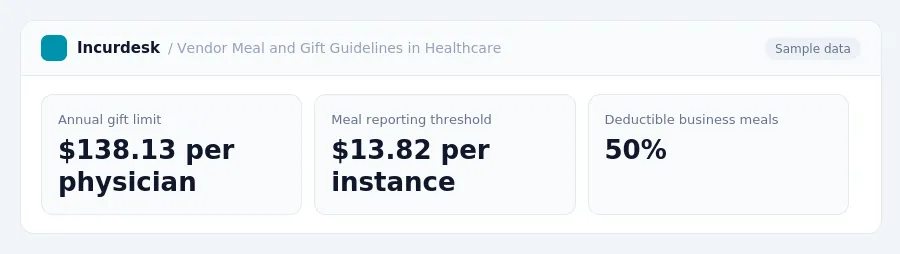
When interacting with pharmaceutical companies and medical device manufacturers, healthcare providers must be aware of specific rules governing vendor meals and gifts. These companies are required to report transfers of value to healthcare providers, including meals, if they exceed $13.82 per instance or $138.13 annually per physician, as per the Centers for Medicare and Medicaid Services (CMS) guidelines in 2026.
- Pharmaceutical companies and medical device manufacturers must track and report all transfers of value, including meals, to ensure compliance.
- Healthcare providers should request itemized receipts for all meals and gifts to maintain accurate records.
- Business meals with pharmaceutical companies and medical device manufacturers are generally 50% deductible, provided they are ordinary, necessary, and not lavish, and an employee or owner is present.
This includes documenting the date, time, location, and value of each meal or gift, as well as the name of the representative from the company.
Healthcare providers should also review their hospital policies on vendor gifts and meals to ensure compliance with CMS guidelines and IRS regulations. This includes establishing clear guidelines for acceptable meals and gifts, as well as procedures for tracking and reporting transfers of value.
Taxation of Meals and Gifts Provided to Employees
When providing meals and gifts to employees, it's essential to understand the tax implications. Here are some key points to consider:
- Cash and gift cards given to employees are considered taxable wages.
- Small, non-cash gifts (like branded apparel or occasional team meals) may qualify as de minimis fringe benefits and are tax-free to the employee and deductible to the business.
- Employee achievement awards for tangible property can be tax-free up to $400 per employee ($1,600 under a qualified plan) if IRS rules are met.
For business meals, the standard deduction is 50% of the cost. To ensure this, keep detailed records of the meal's cost and the purpose of the meal.
When it comes to engraving, packaging, insurance, and shipping costs for gifts, these are not included in the $25 limit and are deductible separately.
Branded promotional items costing $4 or less per item, with the business name permanently imprinted and distributed widely, are treated as advertising expenses, not gifts, and are fully deductible.
For employee travel expenses, the per diem rate varies by locality. For 2026-2027, the high-cost locality per diem rate is $329 per day, and the other localities per diem rate is $230 per day.
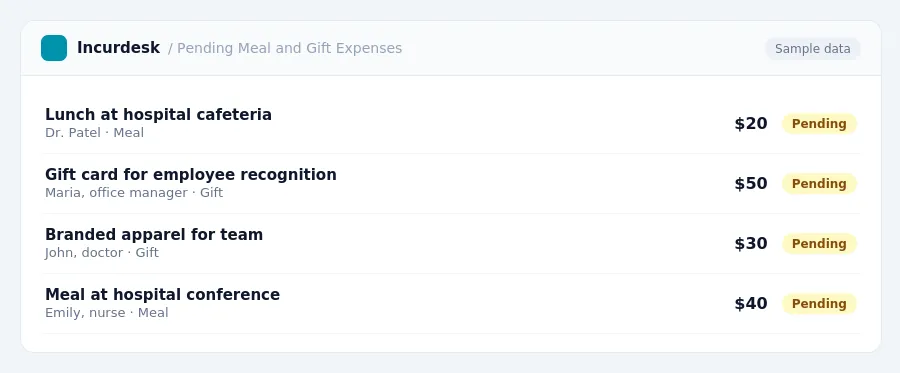
Hospital Policies on Vendor Gifts and Meals
Developing a comprehensive hospital policy on vendor gifts and meals can help ensure compliance with IRS regulations and maintain a transparent business practice. When creating your policy, consider the following guidelines:
- Establish clear rules on accepting gifts, meals, or other items from vendors.
- Require employees to report all gifts, meals, or other items received from vendors.
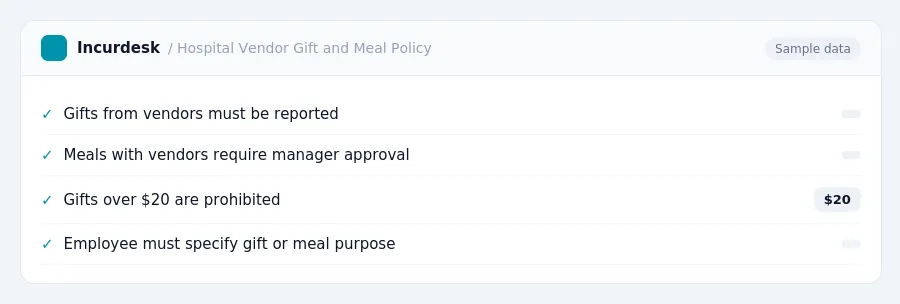
- Specify the types of gifts or meals that are allowed or prohibited, such as meals with vendors or gifts with a value over $20.
- Designate an employee or department to review and approve vendor gifts and meals.
For example, UMass Memorial Health has a policy that mirrors the Sunshine Act logic for internal gifting to physicians.
When drafting your policy, consider the following example:
Keeping this simple: Incurdesk keeps receipts and approvals in one place, which makes a written policy easier to follow. It is built for small hospital teams. Try it free.
Stop losing 4+ hours a week
30-day free trial · No credit card · Setup in 15 minutes