What a Hospital Department Spends on Supplies Per Bed
A practical, data-backed guide to controlling costs and automating expense workflows.
The cost of hospital supplies per bed can vary significantly depending on the department and location. For instance, operating room supply spending was $20,149 per bed annually in 2026, consuming 42.1% of the total supply budget. This significant increase in operating room costs is largely due to the high demand for surgical equipment and supplies, particularly during peak periods. Additionally, the cost of supplies can fluctuate over time due to factors such as inflation rates, supply chain vulnerabilities, and geographic cost variations. For a complete overview, see our expense management guide.
In order to effectively manage expense management for hospitals, it is essential to understand the current average medical supply costs per bed. This includes factors like operating room, intensive care unit (ICU), emergency department, and medical/surgical unit costs. By benchmarking these costs against industry standards and location-specific rates, hospitals can gain a better understanding of their supply costs and make informed budgeting decisions.
Supply Chain Vulnerabilities
In the healthcare industry, supply chain vulnerabilities can have a significant impact on hospital departments. The constant need for timely and accurate inventory management can be challenging, especially for small to medium-sized hospitals. Outbreaks, natural disasters, and other disruptions can disrupt supply chains, leading to stockouts, backorders, and increased costs.
The lack of robust supply chain management can result in inefficient inventory tracking, delayed shipments, and increased costs. This can lead to higher costs per bed, which can affect the bottom line of hospitals. For example, a hospital that relies on a single supplier for medical equipment may experience a significant impact if that supplier experiences a disruption.
Regional and annual variations in supply costs can also make it challenging to benchmark and compare costs across different hospitals. Additionally, the increasing complexity of supply chains due to factors like globalization and e-commerce can make it difficult for hospitals to manage their supply chains effectively.
To mitigate these risks, hospitals should implement robust supply chain management systems, including inventory management software, which can help track and forecast supply chain performance. This can help hospitals to identify potential issues and take corrective action in a timely manner.
Keeping this simple: Incurdesk routes each expense to the right person for approval and keeps a record of who approved what. It is built for small hospital teams. Try it free.
Common Mistakes
When it comes to managing hospital supply costs, there are several common mistakes that can lead to significant financial burdens on small to medium-sized hospitals. One of the most significant errors is ignoring contract compliance. Hospitals that fail to carefully review and adhere to their contracts can find themselves facing costly penalties and fines from suppliers.
Another mistake is reactive procurement, where hospitals wait until the last minute to buy supplies, often at inflated prices. This approach can lead to stockouts, backorders, and wasted resources. Instead, hospitals should proactively review their procurement processes and negotiate with suppliers to secure better deals.
Moreover, relying too heavily on single suppliers can lead to supply chain vulnerabilities. Hospitals should diversify their supplier base to reduce their dependence on a single vendor. This can help mitigate the risks associated with supply chain disruptions, such as price increases, delivery delays, or even supplier insolvency.
Lastly, manual inventory management can be a significant waste of resources. Hospitals should implement electronic inventory management systems to track and monitor their stock levels in real-time. This can help reduce waste, improve efficiency, and ensure that supplies are used effectively.
What a Hospital Department Spends on Supplies Per Bed
The supply costs of hospital departments vary significantly, with Operating Rooms consuming the largest amount. This is a substantial portion of the hospital's overall spending. To understand the scope of supply costs, it's essential to look at the total supply budget, which varies by department and hospital.
For instance, Emergency Departments and Medical/Surgical Units also spend a significant amount on supplies.
To determine the supply costs per bed, we need to know the total supply budget. According to the sources, the total supply budget for a hospital can vary depending on the size and type of hospital. However, it's essential to establish a baseline figure to compare supply costs across different departments.
By understanding the supply costs of different hospital departments, administrators can make informed budgeting decisions, identify areas for cost savings, and optimize their supply chain management.
The rules in this guide
| Amount | Required | In Incurdesk |
|---|---|---|
| Above $50 | Itemised receipt | Checked on every expense |
| Above $250 | Written business purpose | Checked on every expense |
| Above $250 | Names of attendees | Checked on every expense |
| Above $5,000 | Senior sign-off; never auto-approved | Checked on every expense |
Each rule is checked on every expense by Incurdesk’s approval agent.
Key Areas of Spending
When it comes to hospital department supplies, there are several areas that need to be closely monitored to ensure efficient and cost-effective management. Here are the key areas to consider:
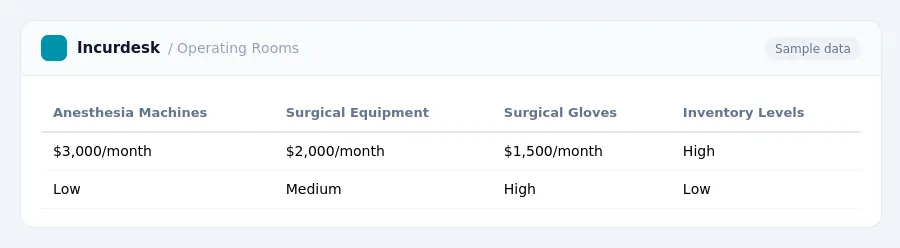
- Operating Rooms: Supplies for operating rooms, such as anesthesia machines, surgical equipment, and surgical gloves, can be expensive. Additionally, the high volume of procedures in this area means that inventory levels need to be closely managed to avoid stockouts and backorders.
- ICUs (Intensive Care Units): ICUs require specialized supplies, including ventilators, dialysis machines, and medication, which can be costly. The ICU environment is also prone to disruptions, such as power outages and equipment failures, which can impact supply costs.
- Emergency Departments: Emergency department supplies, such as beds, bays, and medical equipment, are often underutilized and can be overstocked. This can lead to unnecessary waste and excess inventory.
- Medical/Surgical Units: Medical/surgical units require a range of supplies, including medical equipment, bedding, and linens, which can be expensive. The demand for these supplies can also vary significantly depending on the unit's occupancy and patient volume.
When managing supplies in these areas, it's essential to consider the following:
- Maintain accurate inventory levels to avoid stockouts and backorders.
- Implement efficient procurement and ordering processes to minimize waste and excess inventory.
- Develop effective waste reduction and disposal strategies to minimize environmental impact.
- Continuously monitor supply costs and adjust purchasing strategies as needed to optimize ROI.
- Consider implementing automation or technology solutions to streamline supply management and reduce costs.
Real Questions
Procedure delays and cancellations cost a 300-bed hospital $488,500 annually in backorder-related expenses.
In addition to backorder-related expenses, the hospital also incurs significant costs due to procedure delays and cancellations. These costs can be attributed to various factors, including supply chain disruptions, equipment failures, and staffing shortages.
To mitigate these costs, the hospital should consider implementing a more proactive approach to inventory management. This can include using real-time tracking and monitoring systems to identify potential issues before they become major problems. Additionally, the hospital should explore alternative supply chain options, such as diversifying its supplier base or exploring more cost-effective alternatives.
The hospital's supply chain vulnerabilities should also be considered. For example, the hospital may be more susceptible to supply chain disruptions in certain regions or during specific times of the year. By understanding these vulnerabilities, the hospital can take steps to mitigate their impact and reduce the risk of significant losses.
Tax rules, limits and rates change. Confirm current figures with the IRS or your accountant before you file.
AI expense management for finance teams and whoever keeps the books. It checks every expense against your rules, approves the routine ones and chases missing receipts for you.
Try it free for 30 days →Stop losing 4+ hours a week
30-day free trial · No credit card · Setup in 15 minutes