Who Approves Emergency Roadside Repairs
A practical, data-backed guide to controlling costs and automating expense workflows.
In the event of an emergency roadside repair, the owner or office manager of a small logistics business must determine who has the authority to approve the repair. The procedures for obtaining approval vary depending on the company's policies and local regulations. This includes understanding the documentation required to ensure compliance with Move Over laws, which mandate drivers to slow down or stop for other vehicles in emergency situations. For a complete overview, see our expense management guide.
The driver must then report the incident to the nearest police station and provide the necessary documentation, including the vehicle's make, model, and license plate number, as well as the location of the incident and the time of the incident. The owner or office manager must also ensure that the driver has access to a phone and a means of communicating with the service station or repair shop.
Once the repair is approved, the owner or office manager must document the repair and ensure that the vehicle is safely towed or repaired. For the bigger picture, see our guide to logistics expense management for under $10/user (2026).
Documentation Required for Compliance and Liability
Drivers are required to conduct pre-trip and post-trip inspections, checking critical components like tire pressure, fluid levels, air brake systems, and lighting. (2026)
To ensure compliance, drivers must also follow specific procedures for reporting and documenting roadside repairs. According to the Federal Motor Carrier Safety Administration (FMCSA), drivers must:
- Report any damage or repair to the vehicle to their dispatcher or supervisor within 30 minutes of the incident
- Document the repair, including the type of repair, date, and time
- Keep a record of the repair, including the vehicle's make, model, and year, and the type of repair
It is essential to note that these procedures and documentation requirements vary by state and employer.
Regardless of the company's policies, drivers must also comply with federal regulations, such as those related to Move Over laws. According to the Department of Transportation's National Highway Traffic Safety Administration, 71% of Americans are unaware of these laws, which states that drivers must slow down and move over when they see another vehicle or driver in the next lane.
Keeping this simple: Incurdesk keeps receipts and approvals in one place, which makes a written policy easier to follow. It is built for small logistics teams. Try it free.
While following the procedures for emergency roadside repairs can help minimize potential issues, there are still risks associated with not obtaining the necessary approvals. The consequences of not complying with regulations can be severe.
Similarly, failing to obtain the required approvals can lead to costly delays, which can impact the entire logistics business. In some cases, the business may be forced to pay for the repairs out of pocket, resulting in significant financial losses. Additionally, not obtaining the necessary approvals can lead to a loss of reputation and credibility, as well as potential damage to the business's relationships with customers, insurance providers, and other stakeholders.
It is essential for small logistics businesses to understand the importance of obtaining the necessary approvals for emergency roadside repairs. By following the procedures and taking the necessary steps to obtain approvals, businesses can minimize the risks associated with not complying with regulations and ensure compliance with all relevant laws and guidelines.
Who Approves Emergency Roadside Repairs
Emergency roadside repairs are a critical aspect of fleet management for small logistics businesses.
Professional mobile repair services typically aim for a 45-60 minute response time for emergency scenarios, measured from service request confirmation to technician arrival. Some advanced operations achieve under 30 minutes. This indicates that roadside technicians must be able to respond quickly to emergency situations and that prompt attention is required.
In the United States, all 50 states have "Move Over" laws requiring drivers to move over or slow down for emergency vehicles, service vehicles, or tow trucks. This means that roadside technicians must also follow these laws when approaching emergency vehicles.
Commercial vehicles may be subject to federal requirements for emergency equipment, such as fire extinguishers and roadside warning devices. These requirements include specific ratings for fire extinguishers based on cargo and the requirement for three bidirectional reflective triangles or six fusees.
Proper documentation is crucial for liability, warranty claims, and preventing future incidents. This includes initial incident reports, photos, repair authorizations, service invoices, driver statements, and time logs. Output HTML only.
The rules in this guide
| Amount | Required | In Incurdesk |
|---|---|---|
| Above $75 | Itemised receipt | Checked on every expense |
| Above $250 | Written business purpose | Checked on every expense |
| Above $500 | Names of attendees | Checked on every expense |
| Above $5,000 | Senior sign-off; never auto-approved | Checked on every expense |
Each rule is checked on every expense by Incurdesk’s approval agent.
Understanding the Procedures and Limitations
Who Approves Emergency Roadside Repairs
As a small logistics business owner or office manager, it's essential to understand who has the authority to approve emergency roadside repairs for your commercial vehicles.
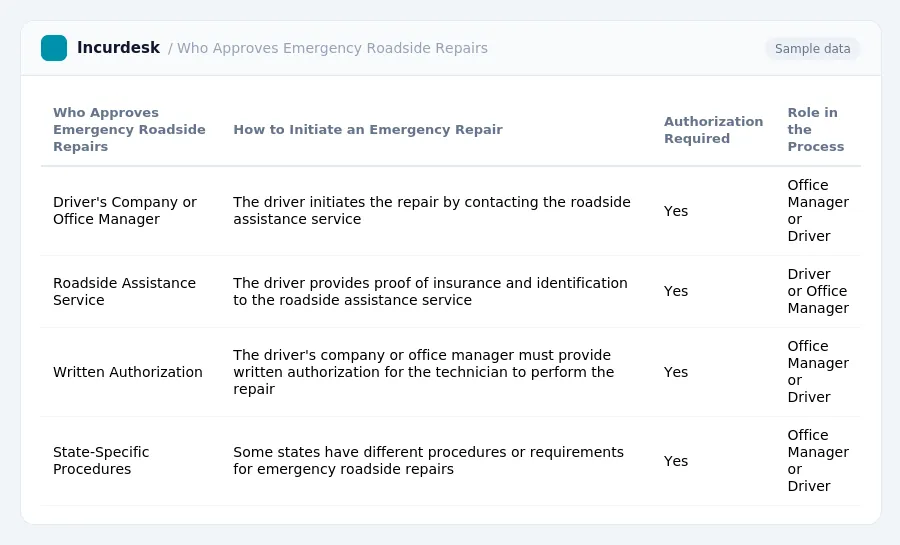
To initiate an emergency roadside repair, the driver typically needs to contact the roadside assistance service, such as the company you have a contract with. The driver then needs to provide proof of insurance and identification to the roadside assistance service. The service will then dispatch a technician to the scene to assess and repair the vehicle.
In most cases, the driver's company or office manager must provide written authorization for the technician to perform the repair.
It's essential to note that some states have different procedures or requirements for emergency roadside repairs. It's crucial to familiarize yourself with the specific laws and regulations in your area to ensure compliance and avoid any potential issues.
Best Practices for Fleet Management and Safety
Who Approves Emergency Roadside Repairs
In the event of an emergency, the person responsible for approving emergency roadside repairs for commercial vehicles is typically the owner of the business or the office manager. However, the specific person or department may vary depending on the size and type of business.
Industry best practices often involve replacing tires at 5/32 for steer tires and 3/32 for drive/trailer tires to prevent roadside failures.
Presidential and State declarations are effective for up to 30 days, while local declarations are effective for up to 5 days. These waivers typically do not apply to drug/alcohol testing, CDL requirements, or hazardous materials regulations.
It is essential to inform all employees and stakeholders about these laws and their importance in maintaining road safety.
Tax rules, limits and rates change. Confirm current figures with the IRS or your accountant before you file.
AI expense management for finance teams and whoever keeps the books. It checks every expense against your rules, approves the routine ones and chases missing receipts for you.
Try it free for 30 days →Stop losing 4+ hours a week
30-day free trial · No credit card · Setup in 15 minutes