Capital Request vs Operating Expense
Real trade-offs, pricing & decision guide — updated November 2026
In the world of hospital business, a key distinction needs to be made between capital expenditures (CapEx) and operating expenses (OpEx) to ensure accurate expense management for hospitals. When it comes to purchasing equipment or supplies, it's essential to understand the difference between these two types of expenses. For a complete overview, see our expense management guide.
When to Use a Capital Request vs Operating Expense
Improvements that add to an asset's value, extend its useful life, or adapt it to a different use are usually capital expenses.
For example, if a hospital upgrades its radiology department, the cost of the new equipment is considered a capital expense because it increases the value and extends the useful life of the department.
The key difference between capital and operating expenses is when they are incurred. Capital expenses are incurred when an asset is added to the business, while operating expenses are incurred when the business is using the asset.
As a hospital business owner or office manager, it's essential to understand when to use a capital request versus an operating expense.
Qualifying Property for Capital Expenditures
When it comes to classifying hospital purchases, there's a crucial distinction to make between capital requests and operating expenses. To accurately report these expenditures for tax and accounting purposes, it's essential to understand the difference.
Capital Requests
A capital request is a purchase that is intended to be held for more than one year and used primarily for business or medical purposes. Qualifying property includes most tangible personal property with a MACRS recovery period of 20 years or less.
Operating Expenses
These purchases are subject to depreciation and are not eligible for bonus depreciation.
To determine whether a purchase is a capital request or an operating expense, consider the following factors:
- Will the purchase be held for more than one year?
- Will the purchase be used primarily for business or medical purposes?
- Is the purchase eligible for bonus depreciation?
If the purchase meets these criteria, it's likely a capital request. If not, it's likely an operating expense.
Capital Request vs Operating Expense: Where Hospital Purchases Fall
The key distinction lies in the purpose and duration of each type of purchase.
CapEx purchases provide long-term value to the business, typically with a useful life of more than one year. These are considered investments and are depreciated over time. Examples of CapEx purchases include equipment, furniture, and real estate.
Examples of operating expenses include salaries, rent, utilities, and supplies.
When it comes to classifying hospital purchases, the distinction between CapEx and OpEx becomes crucial. Businesses must carefully evaluate each purchase to determine whether it qualifies as a CapEx or an OpEx. By understanding the difference, businesses can ensure accurate tax reporting, long-term asset management, and informed financial decision-making.
The rules in this guide
| Amount | Required | In Incurdesk |
|---|---|---|
| Above $50 | Itemised receipt | Checked on every expense |
| Above $250 | Written business purpose | Checked on every expense |
| Above $250 | Names of attendees | Checked on every expense |
| Above $5,000 | Senior sign-off; never auto-approved | Checked on every expense |
Each rule is checked on every expense by Incurdesk’s approval agent.
What is a Capital Request vs Operating Expense?
A capital request is a purchase made by a hospital to acquire property or equipment for the purpose of using it for its intended business function, such as a hospital bed, medical equipment, or a new building. Capital requests are typically made when a hospital needs to purchase property or equipment that will be used for the hospital's operations for at least one year. In most cases, a capital request can be claimed as a business expense on the hospital's tax return.
Operating expenses are not necessarily permanent and can be used for a variety of purposes.
In general, a capital request is more likely to be eligible for tax and accounting purposes than an operating expense, as it is made to support a long-term business goal. However, the specific classification of a purchase as capital or operating can depend on the circumstances of the purchase and the hospital's business needs.
De Minimis Safe Harbor
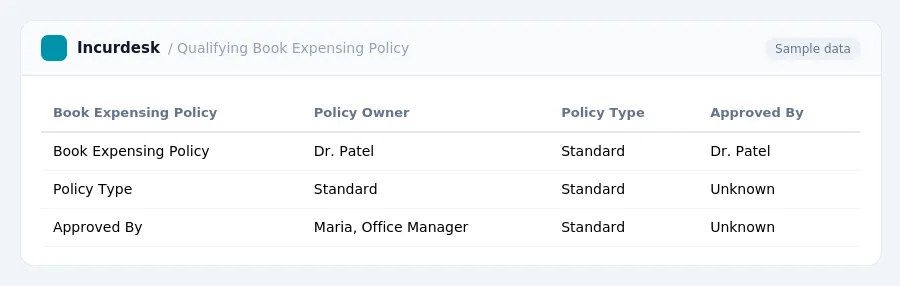
To use the de minimis safe harbor election, a business must have a qualifying book expensing policy in place on the first day of the tax year and file an election statement with its tax return.
This threshold may vary for other types of businesses, such as those in industries with lower employee counts or average annual salaries.
To qualify for the de minimis safe harbor, a business must also meet certain other requirements, including:
- Maintaining a book expensing policy that allows for the treatment of expensed items as expenses on the books
This can be a valuable benefit for businesses with limited budgets and those that want to minimize their tax liability.
Tax rules, limits and rates change. Confirm current figures with the IRS or your accountant before you file.
AI expense management for finance teams and whoever keeps the books. It checks every expense against your rules, approves the routine ones and chases missing receipts for you.
Try it free for 30 days →Neither gets it right. Incurdesk does.
30-day free trial. No credit card. Setup takes 15 minutes.