
Clinic Expense Policy Template: Clinical, Admin, Travel, CME
A practical, data-backed guide to controlling costs and automating expense workflows.
Small healthcare businesses in the US with 5-50 staff can efficiently manage their expenses and minimize costs with the right policies in place. healthcare expense management for under $10/user (2026). By understanding these rules, business owners and office managers can create effective expense policies that save their practice money and reduce administrative burdens.
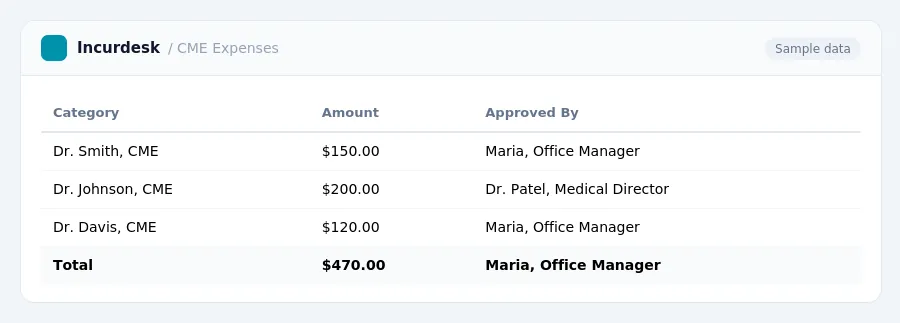
CME Allowances and Reimbursement
Physicians often receive annual CME allowances of $3,500–$5,000, with NPs and PAs typically receiving $2,000–$3,000 annually. Some allowances can range from $3,000 to $10,000.
Employers have varied policies for CME reimbursement, with some providing upfront stipends and others requiring reimbursement upon submission of receipts and certificates.
- Set an annual CME allowance for each provider type: $[3,500–5,000] for physicians, $[2,000–3,000] for NPs and PAs, and $[3,000–10,000] for other staff.
- Determine whether to provide upfront stipends or require reimbursement upon submission of receipts and certificates.
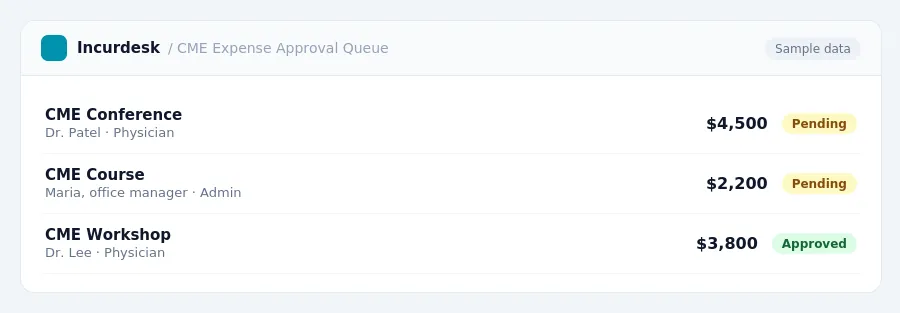
- Establish a process for submitting and approving CME expense reports.
Keeping this simple: Incurdesk lets your team snap a photo of a receipt and fills in the details for you. It is built for small healthcare teams. Try it free.
When creating a clinic expense policy, it's essential to understand the tax implications of different expenses. Here are some key considerations:
- Take advantage of tax-exempt expenses, such as those related to charitable donations or business use of your home.
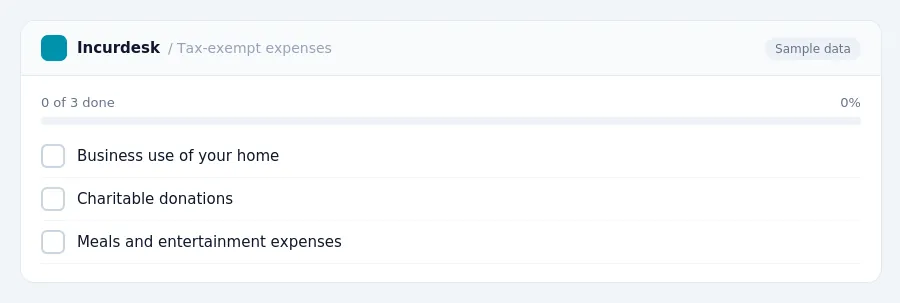
When reviewing your clinic's expenses, consider the following tax-exempt categories:
- Business use of your home, including a dedicated office space
- Charitable donations, including those made by your clinic
- Meals and entertainment expenses, if they meet specific business-related criteria
Keep in mind that tax laws and regulations can change, so it's essential to stay informed and consult with a tax professional to ensure your clinic is in compliance.
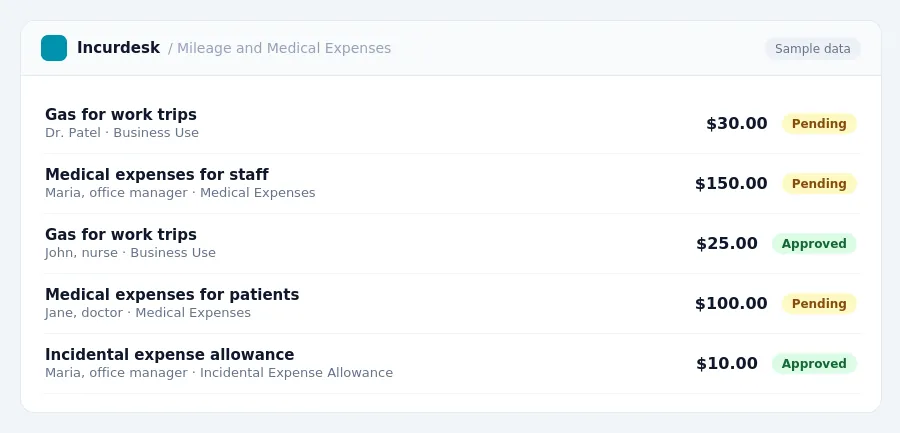
Business Mileage Reimbursement and Medical Expenses
For the period of January 1 to June 30, 2026, the business use rate was 72.5 cents per mile, and the medical purpose rate was 20.5 cents per mile. From July 1 to December 31, 2026, these rates increased to 76 cents per mile for business use and 23.5 cents per mile for medical purposes.
- For business use, you must keep accurate records of miles driven, including dates, destinations, and business purposes.
- For medical purposes, you must obtain a doctor's note or other documentation to support the claim.
When reimbursing employees for business mileage, you can also offer an incidental expense allowance. For the 2026-2027 period, this rate is $5 per day for any CONUS or OCONUS locality.
For unreimbursed medical expenses, you can deduct them on your taxes.
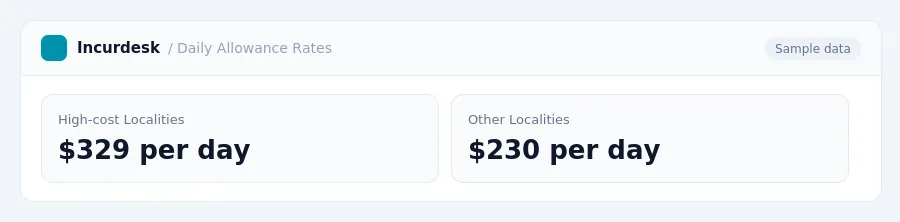
The high-low substantiation method applies to travel within the continental United States (CONUS) for the period October 1, 2026 - September 30, 2027.
- High-cost localities: $329 per day
- Other localities: $230 per day
When reimbursing employees for travel expenses, use these rates to determine the daily allowance. Keep in mind that these rates are subject to change, and you can check the official government website for updates.
When calculating per diem expenses, use the actual expenses incurred for meals and incidentals, but not for lodging. For lodging, you can use the daily rate established by the high-low substantiation method.
Remember to keep accurate records of employee travel expenses, including receipts and itineraries, to support reimbursement claims.
Expense Management Pitfalls and Template
When creating your clinic's expense policy, it's essential to avoid common pitfalls that can lead to financial losses or compliance issues. Here are some practical tips to help you manage expenses effectively:
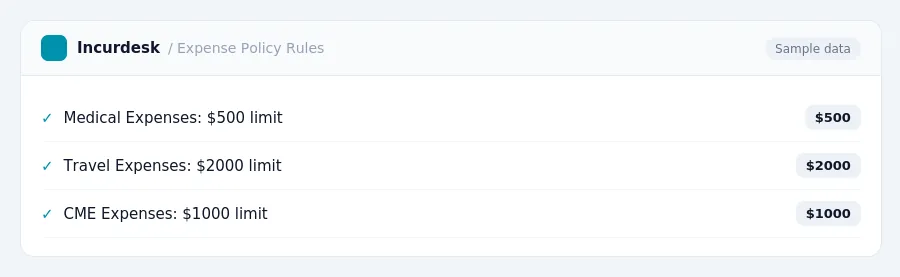
- Clearly define the types of expenses that are eligible for reimbursement, including medical, travel, and CME expenses.
- Establish specific guidelines for submitting expense reports, including deadlines and required documentation.
- Regularly review and update your policy to ensure it remains compliant with changing regulations and laws.
- Consider implementing a system for tracking and monitoring expenses to ensure accuracy and transparency.
- Make sure to communicate your policy clearly to all employees, and provide training on how to follow the guidelines.
To ensure compliance with tax laws, keep accurate records of all business-related expenses, including receipts and invoices.
Expense Policy Template:
| Policy Name: | [Policy Name] |
|---|---|
| Effective Date: | [Effective Date] |
| Eligible Expenses: |
|
| Submission Guidelines: |
|
| Reimbursement Limits: | [Reimbursement Limits] |
Stop losing 4+ hours a week
30-day free trial · No credit card · Setup in 15 minutes