
HIPAA and Receipt Apps: What Actually Matters
A practical, data-backed guide to controlling costs and automating expense workflows.
Small healthcare businesses need to understand that using receipt apps to manage healthcare expenses for under $10/user (2026) does not exempt them from HIPAA regulations. In fact, these apps are considered Business Associates and must adhere to HIPAA standards to protect sensitive patient information. As a result, it's essential to choose HIPAA-compliant apps and establish Business Associate Agreements (BAAs) to avoid potential breaches and penalties. For the bigger picture, see our guide to healthcare expense management for under $10/user (2026).
HIPAA Compliance for Receipt Apps
Any vendor touching ePHI (electronic protected health information) in the US must sign a Business Associate Agreement (BAA) and meet HIPAA's technical safeguards. This means that receipt apps must be designed and implemented to protect ePHI, and must have necessary technical safeguards to prevent unauthorized disclosure or access.
To comply with HIPAA, receipt apps must meet the following requirements:
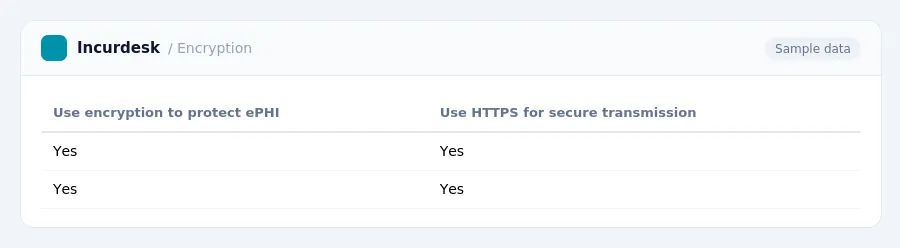
- Use encryption to protect ePHI both in transit and at rest
- Use secure protocols, such as HTTPS, to transmit ePHI
- Implement access controls, such as authentication and authorization, to restrict access to ePHI
- Use secure storage and disposal procedures to protect ePHI
- Conduct regular security audits and risk assessments to identify vulnerabilities
- Keep a record of security incidents and breaches, and report them to the relevant authorities
The requirements for receipt apps are outlined in the HIPAA Security Rule, which is enforced by the US Department of Health and Human Services (HHS). The rule requires that vendors provide BAs to their clients, which includes receipt apps, and that these apps meet the necessary technical safeguards to protect ePHI.
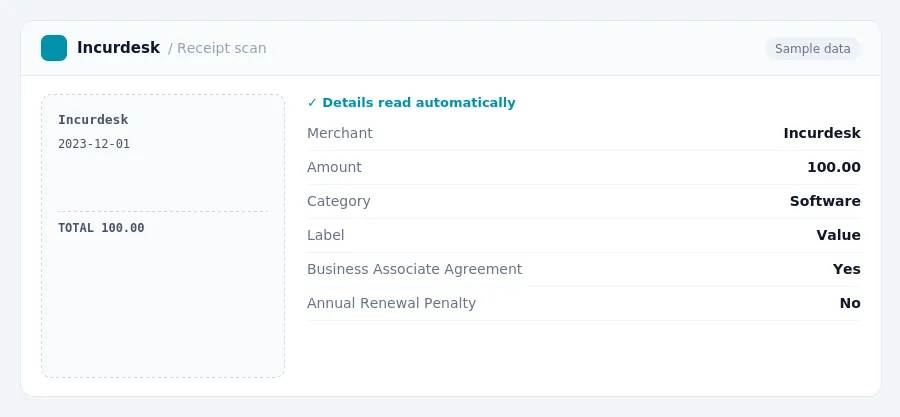
Keeping this simple: Incurdesk lets your team snap a photo of a receipt and fills in the details for you. It is built for small healthcare teams. Try it free.
Business Associate Agreements and HIPAA
As a small healthcare business, you are required to have a Business Associate Agreement (BAA) with an app provider that handles your patients' medical records. A BAA is a legally binding contract that outlines the terms and conditions of how the app will use and protect your patients' sensitive health information.
A BAA is not a one-time agreement, but rather an ongoing contract that must be renewed annually. The agreement must specify the following:
- The type of information the app will handle (e.g. medical records, demographic information)
- The level of security measures the app will take to protect the information
- The procedures for handling breaches or unauthorized access to the information
- The responsibilities of both the business and the app provider
This penalty can be adjusted annually for inflation.
The BAA must also comply with the Health Insurance Portability and Accountability Act (HIPAA) regulations, including the breach definition and reporting procedures. The breach definition requires that an incident in which an unapproved third party access, use, disclose, or delete protected health information (PHI) results in the compromise of protected health information. The reporting procedures require that the business notify the affected individuals and the Secretary of Health and Human Services within 30 days of the breach.
The BAA also requires that the business associate be a business that is responsible for the use and protection of the app provider's software and services. The BAA must be signed by both the business and the app provider, and must be renewed annually.
HIPAA Breach Definitions and Reporting Procedures
When a breach of unsecured Protected Health Information (PHI) occurs, it's essential to understand the reporting procedures and breach definitions to comply with HIPAA regulations.
As a covered entity, you must notify affected individuals without unreasonable delay and no later than 60 calendar days after discovering a breach. This notification must include information such as what happened, what information was involved, and what steps are being taken to address the breach.
However, if PHI was properly encrypted and the encryption key was not compromised, a breach of that data generally does not trigger notification requirements.
It's also essential to understand the potential penalties for HIPAA violations. Civil fines range from a minimum of $100 per violation for an unknowing mistake up to $50,000 per violation for willful neglect.
HIPAA Penalties and Enforcement
Small healthcare businesses must be aware of the financial consequences of non-compliance with HIPAA regulations. Failure to conduct an adequate annual Security Risk Assessment can lead to financial penalties, even for small provider groups. This assessment is the foundation of a HIPAA compliance program.
- State attorneys general can issue fines for HIPAA violations, with maximum penalties of $25,000 per violation category per year, subject to annual inflation adjustments.
- State laws can impose additional penalties on top of federal HIPAA enforcement. State attorneys general have the authority to bring civil actions for HIPAA violations.
It is essential to note that state laws can vary, and the maximum penalties may differ. To determine the specific penalties in your state, you should consult your state's laws and regulations.
Conducting regular Security Risk Assessments and maintaining HIPAA compliance can help prevent financial penalties and ensure the protection of your patients' sensitive information.
HIPAA Security Rule Updates and Best Practices
A breach is defined as the acquisition, access, use, or disclosure of PHI in a manner not permitted by the Privacy Rule that compromises the security or privacy of the PHI. There is a presumption that any impermissible use or disclosure is a breach unless a low probability of compromise can be demonstrated through a four-factor risk assessment.
The proposed HIPAA Security Rule updates would make encryption of ePHI at rest and in transit mandatory, removing the current "addressable" flexibility. This is expected to be a requirement once finalized, though the final rule is targeted for July 2027.
The proposed updates also mandate Multi-Factor Authentication (MFA) for all systems accessing ePHI, with limited exceptions. This means that all employees and contractors will need to use a password, fingerprint, or other form of MFA to access PHI.
While many proposed changes to the HIPAA Security Rule (like mandatory encryption and MFA) are expected to become final, the exact timing and finalization are subject to change. The current target for finalization is July 2027.
Tax rules, limits and rates change. Confirm current figures with the IRS or your accountant before you file.
Stop losing 4+ hours a week
30-day free trial · No credit card · Setup in 15 minutes