
Indirect Cost Rate: What It Actually Covers
A practical, data-backed guide to controlling costs and automating expense workflows.
The indirect cost rate is a crucial aspect of expense management for non-profit organizations, allowing them to recover essential operating expenses that support their programs and services. In the US, nonprofits with budgets under $5 million are generally expected to have a minimum indirect cost rate of 25%, while those with budgets between $5 million and $50 million are expected to have a minimum rate of 20%. By understanding and properly utilizing indirect cost rates, nonprofits can ensure financial sustainability and allocate resources effectively.
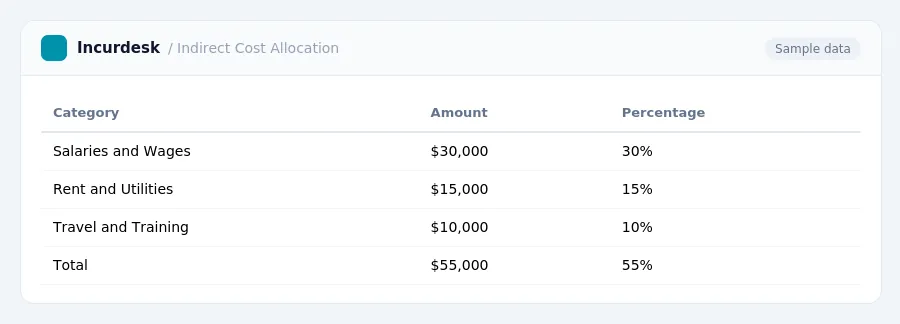
Calculating Modified Total Direct Costs (MTDC)
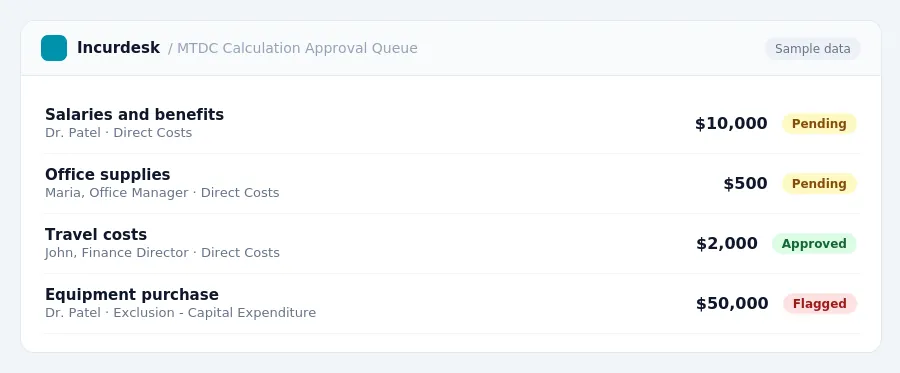
Calculating Modified Total Direct Costs (MTDC) is a crucial step in determining your organization's indirect cost rate. MTDC typically includes your total direct costs less certain exclusions.
These exclusions include:
- Equipment
- Capital expenditures
- Participant support costs
- The portion of each subaward exceeding $25,000 (or $50,000 in some sources)
The cognizant federal agency will typically review your organization's MTDC calculation to ensure compliance with federal regulations. This agency is usually the one providing the most direct federal funding to your organization.
To calculate MTDC, you will need to:
- Identify your total direct costs, which include salaries, wages, and benefits of employees, as well as other direct expenses such as supplies and travel costs.
- Subtract the exclusions listed above from your total direct costs to arrive at your MTDC.
Varying sources may have different requirements for exclusions, so be sure to check with your cognizant federal agency for specific guidance.
Keeping this simple: Incurdesk keeps receipts and approvals in one place, which makes a written policy easier to follow. It is built for small non profits teams. Try it free.
Negotiating an Indirect Cost Rate Agreement (NICRA)
Negotiating an Indirect Cost Rate Agreement (NICRA) is a crucial step for nonprofits seeking to recover their indirect costs. A NICRA is a formal agreement with a federal agency that establishes a specific indirect cost rate based on an organization's actual costs. When negotiating a NICRA, it's essential to understand the rules and guidelines that govern the process.
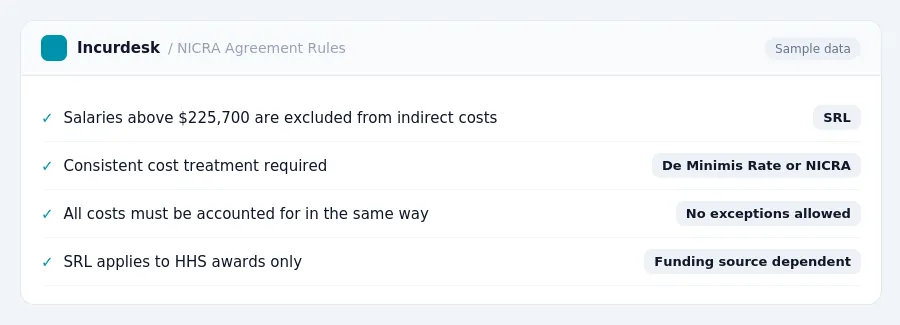
For HHS awards, salaries above the Salary Rate Limit (SRL) of $225,700 (effective January 1, 2025) must be excluded from indirect cost calculations. This means that any salaries above this limit cannot be included in the calculation of indirect costs.
When establishing a NICRA, costs must be treated consistently, whether using the de minimis rate or a NICRA. This means that all costs must be accounted for in the same way, and cannot be treated differently depending on the award or funding source.
It's also essential to note that a cost cannot be charged directly to one award and recovered through the indirect rate on another. This means that organizations must carefully track and account for all costs to ensure compliance with federal regulations.
However, these rates are not applicable to all nonprofits and should not be used as a benchmark without consulting with a federal agency or a qualified expert.
Understanding Indirect Cost Rates
For many nonprofits and educational institutions, the U.S. Department of Health and Human Services (HHS) through its Cost Allocation Services (CAS) acts as the cognizant agency. This means that they oversee and regulate indirect cost rates for these organizations.
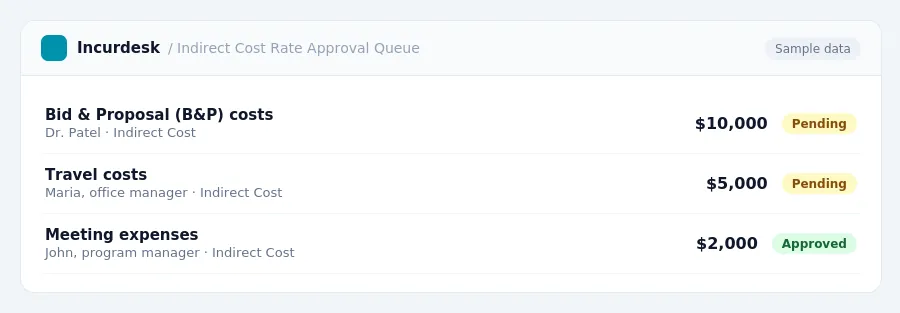
Fundamental to understanding indirect cost rates is knowing what they cover. Indirect costs are not direct expenses, such as salaries, benefits, and fundraising costs, which are considered direct costs and are not allowable in the indirect cost pool. However, indirect costs, such as Bid & Proposal (B&P) costs, are considered indirect expenses and must be documented and accumulated according to Cost Accounting Standards.
The U.S. government allows for indirect cost recovery, but some funders may impose limitations or caps on indirect cost rates. This is why it's essential for nonprofits to understand their specific funder requirements and negotiate an indirect cost rate agreement (NICRA) that aligns with these regulations.
The Packard Foundation has implemented tiered minimum indirect cost rates: 25% for budgets under $5 million, 20% for budgets between $5 million and $50 million, and 15% for budgets over $50 million. Nonprofits should review these guidelines and adjust their indirect cost rates accordingly to ensure compliance and maximize financial sustainability.
What Indirect Costs Actually Cover
Indirect costs are expenses incurred for a common purpose that benefits more than one program and cannot be easily assigned to a specific program without disproportionate effort. These costs are not directly related to a particular project or program, but they are essential to the overall functioning of the organization.
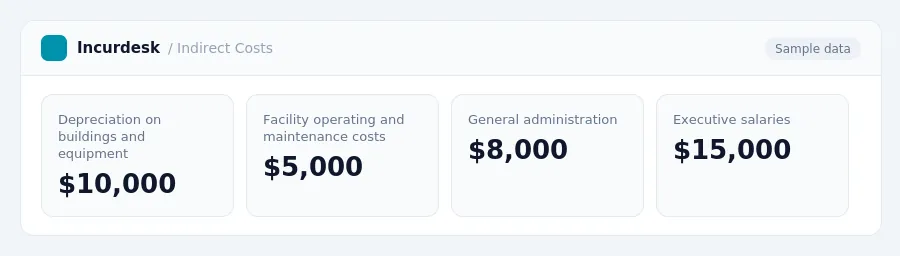
- Examples of indirect costs include depreciation on buildings and equipment, facility operating and maintenance costs, general administration, executive salaries, personnel administration, and accounting.
- Bid & Proposal (B&P) costs are allocated as indirect expenses over the general and administrative (G&A) base.
Indirect costs are typically reimbursed by governments at all levels (local, state, federal) when federal funds are involved. This is because these costs are necessary to support the overall mission and operations of the nonprofit. However, it's essential to note that claiming reimbursement for indirect costs is never mandatory.
However, these rates may vary depending on your organization's specific situation.
Managing Indirect Costs for Financial Sustainability
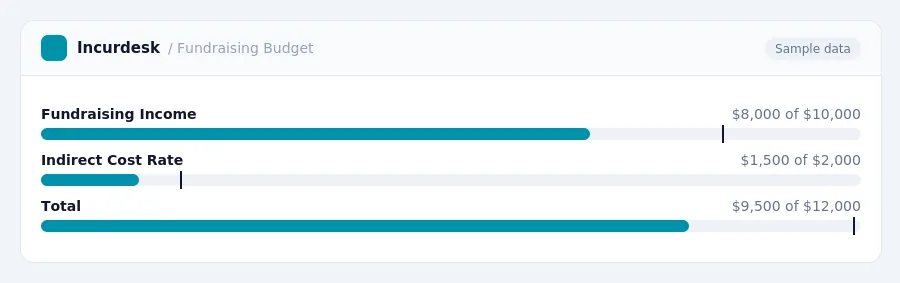
Managing indirect costs effectively is crucial for the financial sustainability of your nonprofit organization. To ensure compliance with federal regulations, apply the indirect cost rate to fundraising costs, which should cover their share of indirect costs. This means you'll need to track fundraising income separately and calculate the indirect cost rate on those funds.
When managing indirect costs, keep the following in mind:
- Track fundraising income separately to ensure accurate indirect cost calculations.
- Monitor your indirect cost rate regularly to ensure it remains compliant with federal regulations.
Consider reviewing your budget and adjusting your indirect cost rate accordingly to ensure financial sustainability.
Stop losing 4+ hours a week
30-day free trial · No credit card · Setup in 15 minutes