
Valuing Donated Goods and Services for Your 990
A practical, data-backed guide to controlling costs and automating expense workflows.
For small US nonprofits with 5-50 employees, valuing and reporting donated goods and services on IRS Form 990 can be a complex task. To ensure accurate financial reporting and effective expense management for non-profit organizations, it's essential to understand IRS requirements and avoid common pitfalls. By following best practices, nonprofits can maximize the value of their donations while maintaining transparency and compliance with IRS regulations.
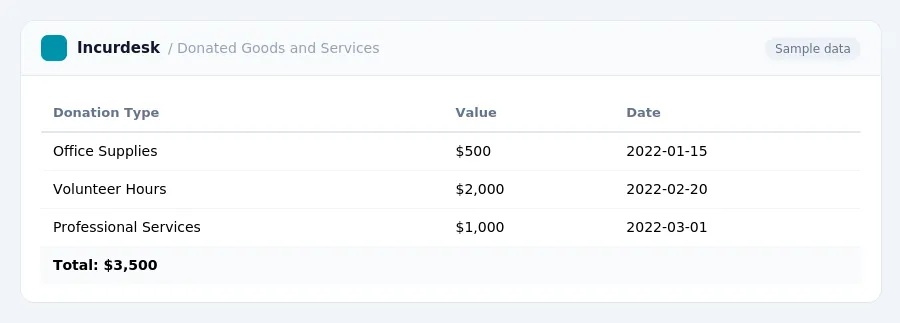
Common Pitfalls and Best Practices for Reporting Donations
When it comes to reporting donated goods and services on Form 990, it's easy to get it wrong. Incorrect reporting can weaken your public support test, make your organization appear more donor-concentrated than it is, and lead to a scramble at filing time. Here are some common pitfalls to watch out for:
- Incorrectly reporting in-kind donations, which can affect your organization's public support test.
- Not following the rules for donated cars, boats, or airplanes valued over $500, which limits the deduction to the gross proceeds from its sale by the organization.
To avoid these pitfalls, make sure to:
- Keep accurate records of all non-cash contributions, including the date, description, and value of each item.
- Value donated items correctly using one of the accepted methods, such as the fair market value or the cost basis.
- Report all non-cash contributions on Form 990, Part VIII, Section A.
- Get an appraisal from a qualified appraiser to determine the fair market value.
- Sell the item in a reasonable time frame and report the gross proceeds from the sale on Form 990.
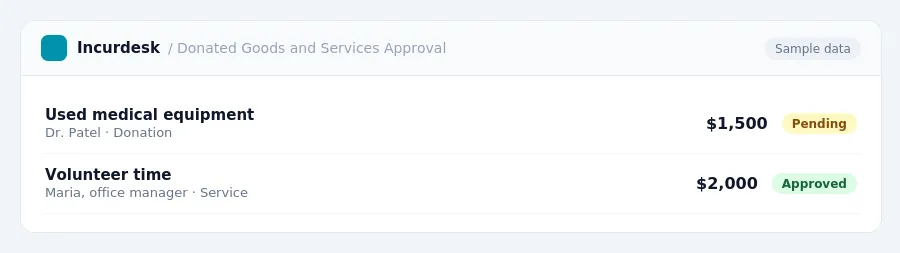
Keeping this simple: Incurdesk keeps receipts and approvals in one place, which makes a written policy easier to follow. It is built for small non profits teams. Try it free.
Tracking and Documenting Non-Cash Contributions
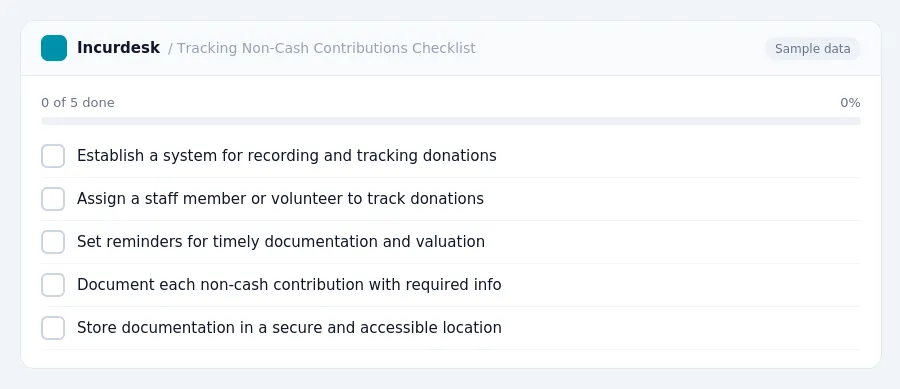
Develop an internal process for tracking non-cash contributions throughout the year to ensure accurate reporting on Form 990. This process should include:
- Establishing a system for recording and tracking donations, such as a log or spreadsheet
- Assigning a staff member or volunteer to be responsible for tracking and documenting non-cash contributions
- Setting reminders or deadlines to ensure timely documentation and valuation of donations
Document each non-cash contribution with the following information:
- Date and description of the donation
- Value of the donation (using one of the IRS-accepted methods)
- Name and contact information of the donor
- Receipt or acknowledgement from the donor, if available
Keep all documentation in a secure and accessible location, such as a designated file or electronic database. This will help ensure that you can easily retrieve the necessary information when preparing your Form 990.
Understanding IRS Requirements for Donated Goods and Services
The IRS requires that in-kind donations be valued at their fair market value (FMV) at the time of donation. For donated goods like food or clothing, FMV is typically the price typical buyers would pay for items of the same age, condition, style, and use.
When valuing donated space, if your organization doesn't normally rent space, you can determine FMV by looking at comparable properties nearby and calculating a per-square-foot rate.
The IRS generally requires a qualified appraisal for a single noncash contribution (or group of similar items) valued at more than $5,000.
Keep in mind that donated services, such as pro bono legal work, volunteer hours, or consulting time, are not reported as noncash contributions on Schedule M or Part VIII of Form 990.
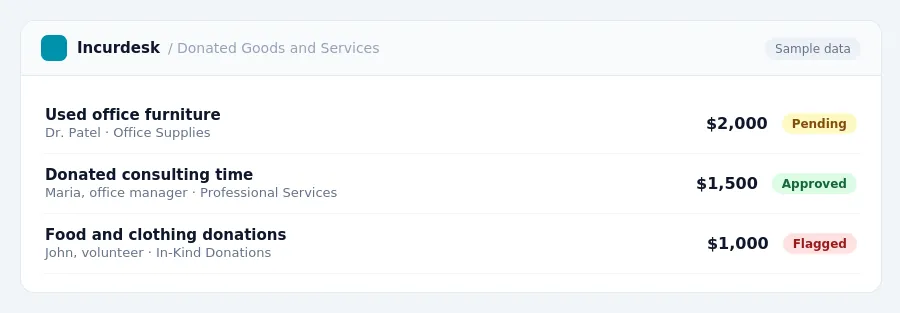
Valuing Non-Cash Contributions: Methods and Considerations
When valuing non-cash contributions, nonprofits must consider the IRS requirements. Non-cash contributions include donations of goods, property, and stocks, but do not include volunteer services or the donated use of materials, facilities, or equipment.
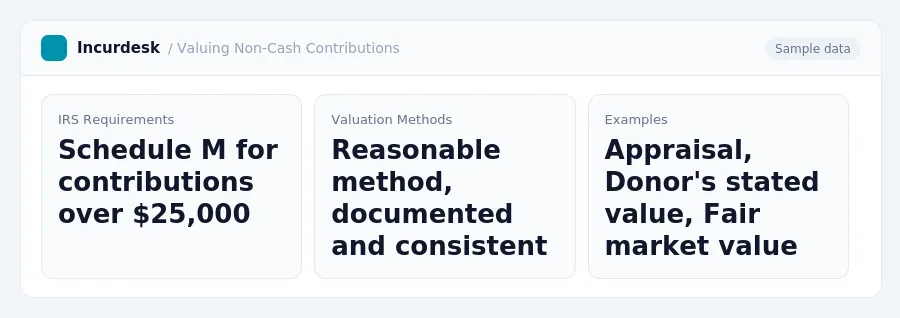
For Form 990 purposes, the IRS requires nonprofits to complete Schedule M if they received more than $25,000 in aggregate noncash contributions during the tax year, or if they received any donation of art, historical treasures, scientific specimens, or qualified conservation contributions, regardless of value.
The IRS allows any reasonable method to determine or estimate the value of non-cash contributions, as long as the method is documented and consistently applied. This may include:
- Obtaining an appraisal from a qualified appraiser
- Using the donor's stated value
- Using the fair market value of similar items
It's essential to document the valuation method used and to consistently apply it from year to year. This will help ensure accuracy and compliance with IRS regulations.
Donor Stewardship and Acknowledgment of Gifts
Donor stewardship is a crucial aspect of building and maintaining relationships with your nonprofit's supporters. When it comes to acknowledging non-cash contributions, it's essential to strike the right balance between expressing gratitude and avoiding any potential tax implications.
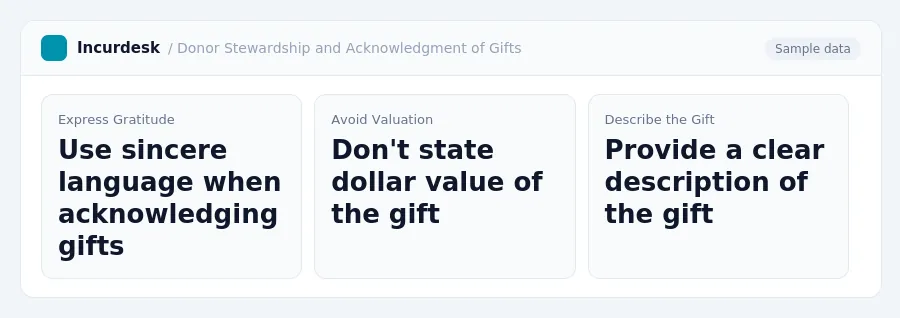
According to the IRS, while the nonprofit must value the gift reasonably for its own reporting, the donor is responsible for obtaining their own appraisal and substantiating their deduction for gifts above $5,000 (source: Key Facts for 2026). This means that when acknowledging a gift, you should focus on expressing gratitude rather than stating its dollar value.
Here are some best practices for acknowledging non-cash contributions:
- Provide a description of the gift, such as "new office furniture" or "professional photography services."
- Acknowledge the donor's generosity with a sincere expression of gratitude, such as "We are grateful for your support" or "Thank you for your donation of [gift]."
- Make sure to include the donor's name and the date of the gift in your acknowledgement.
By following these guidelines, you can show your appreciation for your donors' support while also avoiding any potential tax implications.
Stop losing 4+ hours a week
30-day free trial · No credit card · Setup in 15 minutes