
What Clinics Spend on CME Per Clinician
A practical, data-backed guide to controlling costs and automating expense workflows.
Small healthcare businesses with 5-50 staff in the US can expect to spend around $4,000 annually per clinician on Continuing Medical Education (CME), with approximately 70% of physicians reporting a CME allowance. Employers often provide an allowance to help cover these expenses, which are typically tax-deductible. To manage CME costs effectively, consider budgeting for these expenses and exploring healthcare expense management options for under $10/user (2026). For the bigger picture, see our guide to healthcare expense management for under $10/user (2026).
Navigating State-Specific CME Requirements
State medical boards have varying requirements for CME credits. Most require between 20 and 50 hours per year. For example, Louisiana requires 20 hours of Category 1 CME annually, accumulated over a three-year period.
Each state has its own set of rules, so it's essential to check with your state medical board for specific requirements. You can usually find this information on their website.
- Check your state's medical board website for CME requirements.
- Review the types of CME activities accepted by your state medical board.
- Make sure to keep records of your clinicians' CME credits, including dates and hours completed.
Some states may require specific types of CME, such as patient safety or pain management. Others may have specific requirements for online or live CME activities.
It's crucial to stay up-to-date on your state's CME requirements to avoid any potential penalties or fines.
Keeping this simple: Incurdesk lets your team snap a photo of a receipt and fills in the details for you. It is built for small healthcare teams. Try it free.
Managing CME Expenses for Employed Clinicians
As a small healthcare business owner or office manager, understanding the costs associated with Continuing Medical Education (CME) is crucial for budgeting and compliance. Employed clinicians, in particular, need to be aware of the expenses and rules surrounding CME.
The DEA has mandated that all practitioners registering or renewing with the DEA must complete a one-time, 8-hour training on treating and managing patients with opioid or other substance use disorders. This training is a one-time expense for clinicians, but it may be tax-deductible.
Employed clinicians can expect to receive a CME allowance from their employer, which is typically a percentage of their salary. The average CME allowance for physicians is approximately 70% of their salary, with a median of $4,000 annually. However, this amount can vary depending on the employer and the clinician's salary.
To manage CME expenses for employed clinicians, it is essential to:
- Review the employer's CME allowance policy
- Calculate the CME allowance amount based on the employer's policy
- Keep records of the CME training completed and the hours attended
- Report the CME hours to the employer and the relevant authorities, as required by law
It is also essential to note that employers may not always be able to provide a specific CME allowance amount, as this can vary depending on the employer's policies and the clinician's salary. However, the employer's policy will typically provide a clear guideline on what is expected.
Understanding CME Expenses and Tax Deductions
As a small healthcare business, it's essential to understand the tax implications of Continuing Medical Education (CME) expenses for your clinicians. CME expenses are generally tax-deductible for self-employed physicians, independent contractors, and LLC owners as a business expense on Schedule C.
However, employed physicians (W-2) may not be able to deduct unreimbursed expenses due to the Tax Cuts and Jobs Act of 2017. But, they can benefit from employer reimbursements up to $5,250 annually under IRS Section 127.
When it comes to travel expenses, the high-low per diem rate for travel away from home beginning October 1, 2026, is $329 for high-cost localities and $230 for other localities. The Meals & Incidental Expenses (M&IE) portion is $86 for high-cost localities and $74 for other localities.
It's also essential to keep track of the cost per CME credit. A reasonable target is $25–$40, and consistently above $60 is considered wasteful.
International CME conferences follow similar rules to domestic ones, but the IRS may apply additional scrutiny to trips longer than a week outside the U.S.
To ensure compliance, keep accurate records of CME expenses, including receipts, invoices, and attendance certificates. This will help you take advantage of tax deductions and avoid any potential issues with the IRS.
Approximately 70% of physicians report a CME allowance, with a median of $4,000 annually. This can help you budget for CME expenses and ensure your clinicians have the necessary resources to stay up-to-date with the latest medical knowledge.
Determining Allowance Amounts for Clinicians
When determining allowance amounts for clinicians, it's essential to consider the specific requirements and norms of their specialty. According to recent data, certain specialties like Otolaryngology, Pathology, and General Surgery report a median allowance of $5,000 annually. In contrast, Nurse midwives, physician assistants, and nurse practitioners typically receive a median allowance of $2,000 annually.
To give you a better idea, here are some specific allowance amounts:
Keep in mind that these are general guidelines, and actual allowance amounts may vary depending on your specific business and location. If you're unsure about the typical allowance for your clinicians, you can consult with industry associations or review data from reputable sources.
Budgeting for CME Credits and Compliance
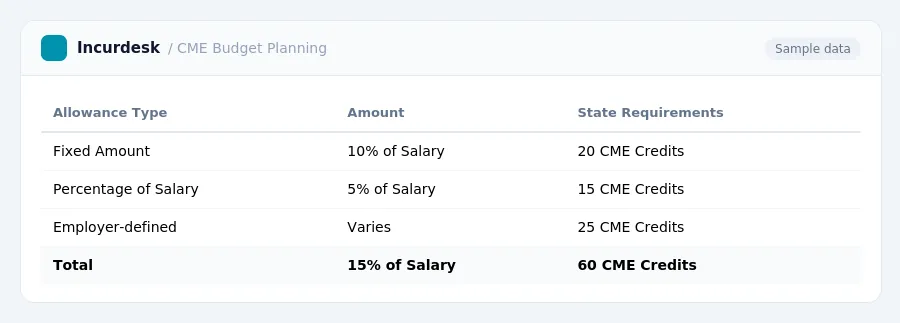
When it comes to determining how much to spend on CME for your clinicians, it's essential to understand the rules and guidelines that apply to your situation.
First, consider the rules that dictate how much CME allowance you can provide to your clinicians. However, this percentage may vary depending on the state and the specific circumstances of your practice.
Employer-provided CME allowances can also vary. Some employers may offer a fixed amount per clinician per year, while others may offer a percentage of the clinician's salary. It's essential to review your employer's policies and procedures to determine what CME allowance amount you can provide.
When determining how much to spend on CME, you should also consider the state-specific requirements for CME credits. Some states require clinicians to complete a certain number of CME credits to maintain their licensure, while others may require a specific percentage of their total practice time to be devoted to CME. Research the specific requirements in your state to ensure you're meeting your obligations.
It's also worth noting that CME expenses may be tax-deductible. This tax deduction can help reduce your taxable income and increase your take-home pay.
Stop losing 4+ hours a week
30-day free trial · No credit card · Setup in 15 minutes