
When a Nonprofit Has Outgrown Manual Expense Approvals
A practical, data-backed guide to controlling costs and automating expense workflows.
A well-executed expense management for non-profit organizations
Common Mistakes to Avoid in Expense Reimbursement
Here are some common pitfalls to watch out for:
- Lacking a written policy: Without a clear, written policy, it's easy to get reimbursement requests mixed up or misclassify expenses. Take the time to create a comprehensive policy that outlines what expenses are reimbursable and how to submit requests.
- Insufficient documentation: Keep detailed records of all expenses, including receipts, logs, and explanations of business connection. This will help ensure that reimbursements are legitimate and that you can substantiate expenses in case of an audit.
- Delayed submissions: Make sure employees and volunteers submit reimbursement requests in a timely manner to avoid delays in processing and payment.
- Reimbursing personal expenses Ensure that all expenses have a clear business connection.
- Misclassifying reimbursements Consult with a tax professional if you're unsure.
Keeping this simple: Incurdesk keeps receipts and approvals in one place, which makes a written policy easier to follow. It is built for small non profits teams. Try it free.
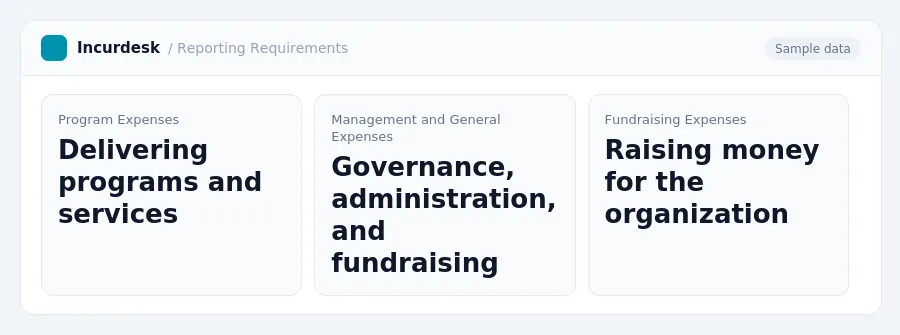
The form requires nonprofits to categorize expenses into three main areas: program expenses, management and general expenses, and fundraising expenses. Make sure to accurately classify each expense to avoid any potential issues.
You would categorize this expense as a management and general expense, as it's related to the governance and administration of your organization.
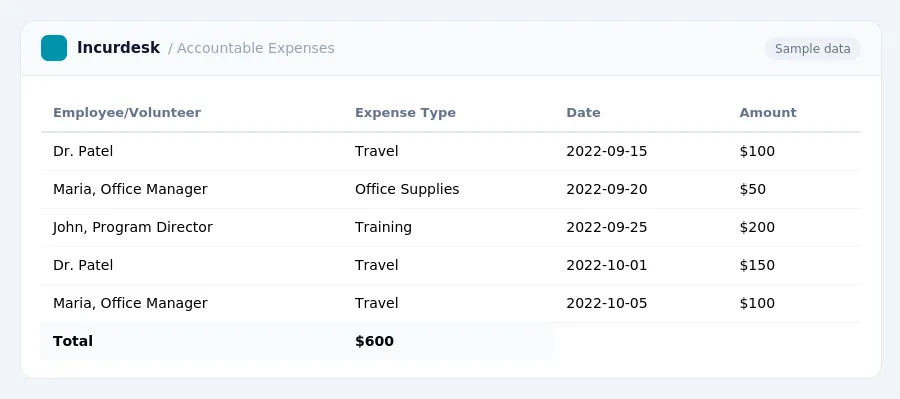
When completing Form 990, also be sure to report the total amount of expenses reimbursed to employees and volunteers. This includes mileage, meals, and other business-related expenses.
Some states may have additional forms or deadlines for reporting expenses.
Form 990 Reporting Requirements:
- Program expenses: costs related to delivering your nonprofit's programs and services
- Management and general expenses: costs related to governance, administration, and fundraising
- Fundraising expenses: costs related to raising money for your nonprofit
State Reporting Requirements:
An accountable plan requires business connection, meaning the expense must be related to the employee's or volunteer's work duties. It also requires adequate substantiation, which can include receipts, logs, and other documentation.
Here are the key elements of an accountable plan:
- Adequate substantiation: The employee or volunteer must provide documentation to support the expense.
- Return of excess funds: If an employee or volunteer is reimbursed for an expense that is later determined to be personal in nature, the excess funds must be returned to the nonprofit.
Documenting Business Expenses for Reimbursement
For your nonprofit to reimburse employees and volunteers for business expenses, you'll need to keep accurate records. An accountable plan requires that expenses have a business connection, are adequately substantiated within a reasonable period, and any excess advances are returned within a reasonable period.
- Expenses must be ordinary (common and accepted in the industry) and necessary (useful and suitable for the business), and not lavish or extravagant.
- Personal expenses cannot be reimbursed.
Adequate documentation typically includes:
- Receipts
- Canceled checks
- Invoices
For expenses of $75 or more, and for all lodging expenses, receipts are generally required. A contemporaneous log with dates, destinations, and purposes is required for mileage.
For travel to high-cost locations, the rate is $319, while for travel to other locations, the rate is $225. For meals and incidental expenses (M&IE) only, the rate is $86 for high-cost locations and $74 for other locations.
Stop losing 4+ hours a week
30-day free trial · No credit card · Setup in 15 minutes