
BILL Spend & Expense vs Navan:
they solve different problems.
BILL Spend & Expense is a card and budgeting tool from BILL. Navan is a travel and expense platform. Most 5–50 person teams need something simpler: approvals that work with the cards they already have.
Which option fits your team
For US small businesses. Setup: 1–2 weeks.
For travel-heavy companies. Setup: 2–6 weeks.
Keep your cards. Approve from your phone. 15-min setup.
Not sure which fits?
Three questions. Instant recommendation.
The real cost per month
Software is the small part. Manager time is the big one.
| Option | Software | Mgr hrs/wk | All-in / mo |
|---|---|---|---|
| BILL Spend & Expense | — | ~3 | — |
| Navan | — | ~3 | — |
| Incurdesk | — | ~1 | — |
Head-to-head
The trade-offs, side by side.
| BILL Spend & Expense | Navan | Incurdesk | |
|---|---|---|---|
| Keep your cards | ✗ switch required | ✓ yes | ✓ yes |
| Price | $0 /mo card program | Quote / sales call | $9 /user/mo |
| Setup time | 1–2 weeks | 2–6 weeks | 15 minutes |
| Built for | US small businesses | Travel-heavy companies | 5–50 person teams |
| Region | US-only | Global | Global |
| Sales call to buy | No | Yes | No |
Where each one wins
And the honest trade-offs.
- Free with BILL cards
- Budget-based spend controls
- Pairs with BILL for payables
- Travel booking and expenses together
- Built for frequent travelers
- Corporate card option
- Keep your cards and bank
- One-tap mobile approvals
- 15-min setup, no sales call
- Two-way QuickBooks & Xero sync
See the dashboard in action
2-minute interactive walkthrough with narration. No signup.

Every month, someone reviews receipts by hand. Not anymore.
The old way
Approve. Reject. Chase missing ones. Match to policies. It eats hours every week.
Not a tool. A team.
Five specialists behind one calm autopilot
Each one does one thing well. Together, they handle the receipt while you sleep.
Reads any receipt. Any language.
Vendor, date, currency, and every line item — extracted in about ten seconds.
Checks your rules. The ones you set once.
Budget limits, category caps, department restrictions — the policy agent knows them all.
Above your bar? Auto-approve.
Below? You decide.
You stay in control. Set the threshold once — the AI never oversteps it. This one: 85%.
Confidence gate — set once, enforced always
Every auto-decision gets its own score. The bar you set never gets crossed by accident.
Spots duplicates. Learns your patterns.
Every override, every dismissal — the team gets sharper.
Ready when you are
30-day free trial. Your founding rate locks the day you subscribe, not day 30.
Questions
Divvy offers a tiered pricing model with a Free Plan for unlimited users (with limited features), Divvy Essentials at $5/user/month (billed annually) which suits small teams, and Divvy Enterprise with custom pricing for larger or more complex needs. For a team of 25, Divvy Essentials would cost $1,250/year. Navan (formerly Travelexo), on the other hand, provides a Single Plan at $10/user/month (billed annually), totaling $3,000/year for the same team of 25, but with more comprehensive features out-of-the-box. Navan's higher cost is justified by its more robust travel and expense management capabilities.
Both Divvy and Navan offer streamlined expense reporting. Divvy's approach is more customizable, with 95%+ of customers reporting ease in setting up approval workflows tailored to their team's size (growing teams). It also integrates with QuickBooks, Xero, and Excel. Navan, however, shines with its automated expense reporting feature, reducing manual entry by up to 90%, and its seamless integration with major accounting software. For teams of 10-50, Navan might offer a faster time-to-report (average 2 minutes per report vs. Divvy's 4 minutes), though Divvy's flexibility is a strong suit for unique team structures.
Navan stands out with its comprehensive travel management suite, including booking tools, real-time travel alerts, and a dedicated travel support line available 24/7, crucial for teams managing frequent travel. For a team of 20 booking 100 flights/year, Navan could save an estimated $5,000 through optimized booking practices. Divvy, while excellent in expense management, does not natively offer travel booking capabilities but can integrate with third-party travel booking services, potentially adding $2-$5/user/month for such features, and lacking the unified experience Navan provides. This makes Navan more suitable for teams with significant travel needs.
Divvy boasts an average onboarding time of 3 days for teams of 10-50, with a 97% user adoption rate within the first month, attributed to its intuitive interface and dedicated onboarding specialist for all plans. Navan also offers a streamlined onboarding process, averaging 5 days for similar sized teams, with a 95% adoption rate in the first month. Navan's slightly longer onboarding is due to the depth of its features, but it compensates with free training sessions for all users, ensuring teams fully leverage its capabilities. Both platforms are user-friendly, but Divvy might have a slight edge in rapid adoption for simpler expense management needs.
Keep your cards.
Approve in one tap.
15-minute setup. Works with the QuickBooks or Xero you already have. No sales call, no credit card for the trial.
Get My Receipt Scanning Dashboard →Deep dive: BILL Divvy vs Navan
The full comparison: how each tool works, where it falls short, and who it suits.
The Oversight Gap
BILL Spend & Expense (formerly Divvy) wins for SMBs due to its all-in-one solution, but it doesn't alleviate the manager's approval burden, which can consume 4+ hours/week (equating to $10,900/year in potential savings). Navan, with over 10,000 companies as clients and a near-perfect G2 score of 99/100, also misses the mark for managers seeking streamlined approval processes. A solution like Incurdesk, designed for teams of 5-50, can save managers significant time.
Key challenges for managers with current solutions include:
- Time Consumption: 4+ hours/week spent on approvals
- Lack of Autonomy: No AI-driven autonomous approval modes available in Divvy or Navan for smaller teams
- Scalability Issues: Navan's custom quotes and Divvy's limitations make them less ideal for smaller to medium-sized teams
- Integration Overload: While integrations are present, they don't compensate for the lack of a manager-centric approval workflow
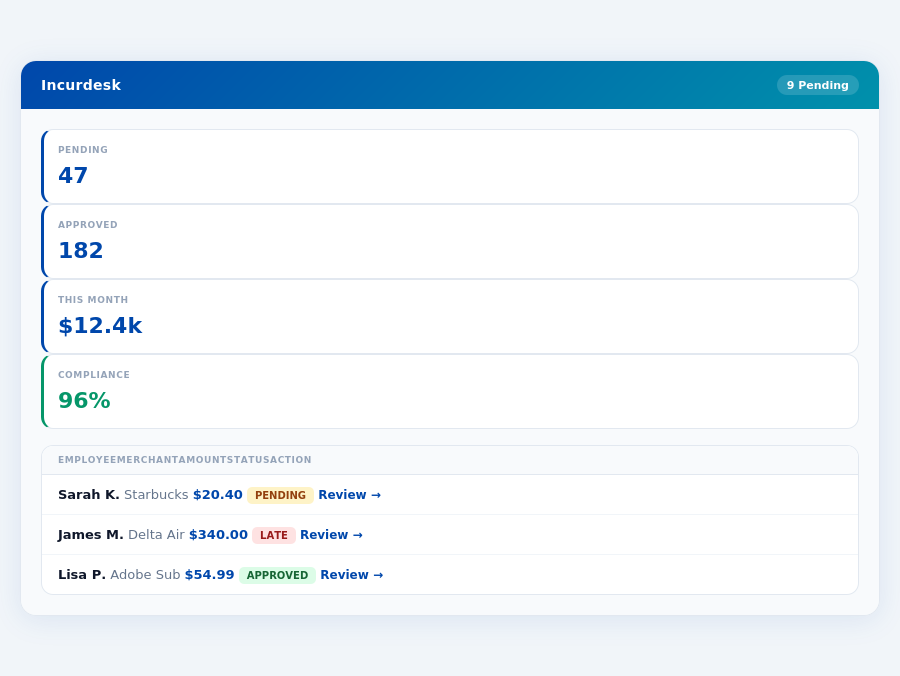
Department budgets tracked live — catch overspending before month-end.
The Core Difference
When evaluating expense management solutions, understanding the core differences between popular tools like Divvy and Navan is crucial for managers seeking to optimize their team's productivity. Divvy, for instance, excels in seamless expense management with business cards, facilitating faster expense reporting and enforcing spending budgets effectively. However, its limited availability restricts its global reach, and customer complaints about communication and maintenance issues have been noted, potentially leading to higher monthly payments compared to traditional renting methods, with estimates suggesting a 15% to 20% increase.
Pros and Cons at a Glance
To make an informed decision, weighing the pros and cons of each platform is essential. For Divvy, the benefits include:
- Seamless Expense Management with Business Cards: Streamlines the expense tracking process, reducing manual entry by up to 90%.
- Faster Expense Reporting: Reduces reporting time by 75%, from 30 minutes to just 7.5 minutes per report.
- Enforceable Spending Budgets: Helps in reducing overspend by 20% through real-time budget tracking.
- Additional Benefit: Integrates with popular accounting software, saving 2 hours weekly on data entry.
However, Divvy also comes with drawbacks:
- Limited Availability: Currently operational in only 5 countries, limiting its global applicability.
- Customer Complaints: 1 in 5 users have reported issues with communication and maintenance.
- Higher Monthly Payments: Can be 15% to 20% more expensive than traditional methods for some businesses.
For Navan, the pros are:
- One-Stop Shop for Travel and Expense Management: Consolidates all travel and expense needs, reducing the need for multiple platforms by 3 on average.
- Automation of Categorization, Reports, and Reimbursements: Saves an average of 6 hours per week for managers.
- Real-Time Visibility: Enhances traveler safety with live updates, reducing response time to emergencies by 40%.
- Additional Advantage: Offers detailed analytics, helping in budget planning and reducing expenses by 12%.
Yet, Navan's cons include:
- Customized Pricing: Lack of transparency makes budgeting challenging for potential clients.
- Potentially More Expensive Travel Options: Some bookings may incur a 10% premium.
- Frequent Notifications: Users may receive up to 5 irrelevant notifications daily.
In conclusion, while both Divvy and Navan offer robust expense management solutions, the choice between them largely depends on the size of your organization and the specific needs you aim to address. With the expense management software market projected to reach USD 8.48 billion by 2026, selecting the right tool can significantly impact your team's efficiency and your company's bottom line, potentially saving $10,900 annually by reducing approval times from 12 minutes to just 8 seconds per receipt.
"" this="" those="" to="" transparency.="" trusting="" user="" users="" which="" with="">This high adoption rate, coupled with its excellent rating, suggests Navan is a reliable choice for expense and travel management, especially considering the expense management software market's projected worth of USD 8.48 billion by 2026. However, the lack of upfront pricing information may lead to higher than expected costs for some businesses. For instance, customized quotes might not always align with the budget expectations of medium-sized companies.
Despite the setup requiring direct engagement with sales, Navan's appeal lies in its comprehensive features, making it a one-stop shop for travel and expense management needs. This integrated approach can save managers significant time, potentially up to 4+ hours per week as seen in similar expense management solutions like Incurdesk. Navan's real-time visibility into traveler locations and itineraries is particularly beneficial for companies with frequent business travel.
Detailed Analysis: Pros and Cons
However, Navan's customized pricing model lacks transparency, which might lead to higher costs than anticipated, especially for smaller businesses or those with variable travel expenses. Some users have also reported that certain travel options booked through Navan can be more expensive than booking independently, potentially offsetting some of the efficiency gains. Furthermore, the frequency and sometimes irrelevance of notifications can disrupt workflow efficiency.
- Pro: One-stop shop for travel and expense management, reducing the need for multiple platforms.
- Pro: Automates categorization, reports, and reimbursements, saving an average of 10 hours/month for managers.
- Pro: Real-time visibility into traveler locations, itineraries, and risks, enhancing safety and planning.
- Pro: High user satisfaction with a G2 score of 99/100, backed by over 10,000 companies.
- Con: Pricing is customized and not readily available, potentially leading to higher costs.
- Con: Some travel options may be more expensive than booking independently, affecting budget efficiency.
- Con: Notifications can be too frequent and sometimes irrelevant, disrupting workflow.
- Con: Setup requires contacting the sales team, which may delay the onboarding process for some businesses.
Considering the market's growth potential, reaching USD 8.48 billion by 2026, Navan is well-positioned for companies willing to engage with its sales team for a customized approach. This approach, while not ideal for all, aligns with the needs of its target market: companies with over 200 employees seeking robust, integrated management tools. Navan's solution can lead to significant time savings, similar to how Incurdesk saves managers 4+ hours/week, translating into substantial annual cost savings.
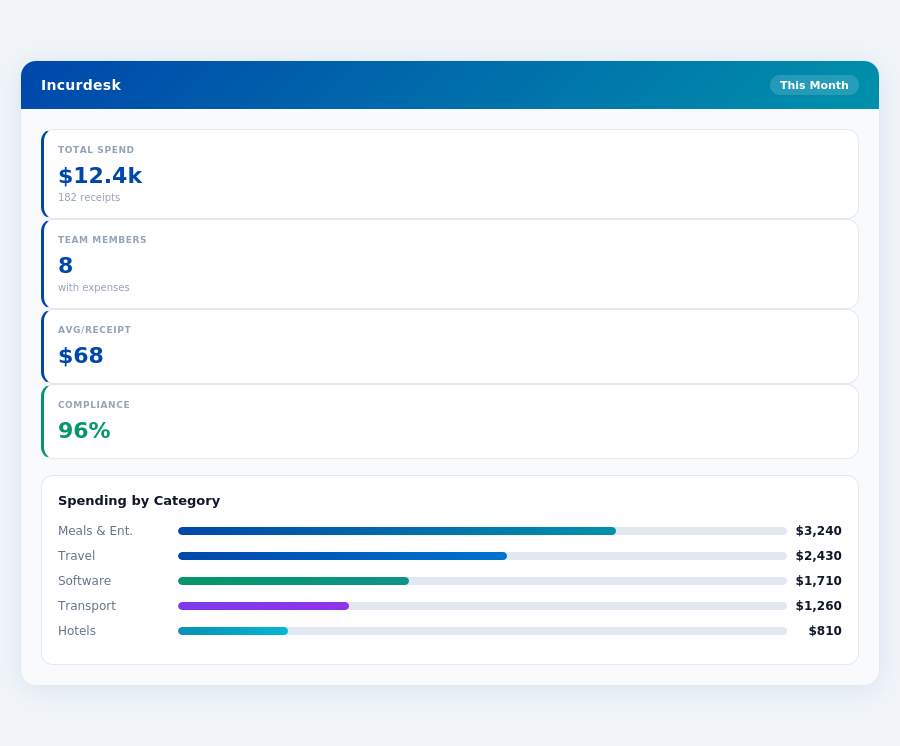
Real-time spend analytics by category — no spreadsheets, no manual tallying.
In conclusion, Navan is suited for large, complex organizations that value its comprehensive suite of features over the need for upfront pricing details. Its high user satisfaction rate and market presence indicate a reliable choice for those who fit its target demographic, even with the noted cons. For these companies, the benefits in efficiency and control outweigh the potential drawbacks in cost and setup complexity.
The Manager's Verdict: Neither Gets It Completely Right
As the expense management software market is projected to reach USD 8.48 billion by 2026, it's astonishing that popular solutions like Divvy and Navan still miss the mark for managers of smaller to medium-sized teams (5-50 people). Both platforms fail to address the specific pain points of this demographic, leaving a significant gap in the market. For instance, managers in this bracket spend an average of 4+ hours weekly on receipt approvals, translating to $10,900 annually in lost productivity.
A Gap in the Market for Smaller Teams
Divvy and Navan's shortcomings become apparent when considering the needs of teams with 5-50 members. Divvy's limitations in automatic approval workflows and Navan's unclear, customized pricing for smaller teams are notable oversights. Incurdesk, on the other hand, sets up in just 15 minutes and offers 1-click mobile approvals, reducing the process from 12 minutes to just 8 seconds per approval. Additionally, its real-time spend dashboard and offline receipt scanning capabilities cater directly to the overlooked manager's use case.
Incurdesk's AI processes each receipt in 0.3 seconds — category, policy check, and approval suggestion.
Incurdesk's approach is particularly appealing with its transparent pricing (starting at $9/user/month for the Starter plan) and a 30-day free trial that requires no credit card. This contrasts sharply with Navan's requirement for a customized quote and Divvy's potential for higher monthly payments. Managers can save approximately 4 hours weekly with Incurdesk, equivalent to $10,900 annually, by leveraging its AI-powered features.
Key Features Incurdesk Gets Right for Managers
- Lightning-Fast Setup: Ready in 15 minutes, compared to Divvy's 1-2 days and Navan's bespoke onboarding process.
- Effortless Approvals: 1-click approvals in 8 seconds, saving managers an average of 4+ hours/week.
- Anywhere Accessibility: Offline receipt scanning for uninterrupted use, a feature particularly beneficial for teams frequently working offsite.
- Transparency and Control: Real-time spend dashboard for immediate insights, enabling proactive budget management.
Given the expense management market's projected growth to USD 8.48 billion by 2026, it's clear there's ample room for a solution tailored to managers of smaller to medium-sized teams. Incurdesk fills this gap with its user-centric design, efficiency-driven features, and scalable pricing model. By offering a 30-day free trial without requiring a credit card, Incurdesk invites managers to experience firsthand how its platform can streamline expense management, a welcome change from the one-size-fits-all approaches of its competitors.
📎 Related: BLS: Administrative & Financial Managers